Similar Posts
What’s Missing on 14th St?
ByDonFoxy Lady is GONE!
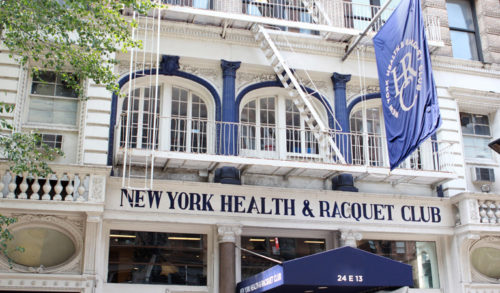
Changes to NYHRC on East 13th
ByDonInformation is sketchy, but it appears that Pan Am Equities, the real estate company that owns the collection of “True North” apartment buildings, including one on our 13th St. block, is now in the process of reconfiguring 24-26 East 13th St., the former home of the New York Health and Racquet Club, into 39 apartments, up from the previous 24. The ground floor and basement may once again hold a fitness facility. It’s unclear if the overall size of the building will change, but it appears not.
Bar 13 Goes Non-Alcoholic
ByDonThat’s weird. Bar 13, which has been at the corner of University and 13th for more than 20 years, has been reborn as Cheers NYC, which is a non-alcoholic bar. Mocktails only. Go figure. Seems it’s true the kids are drinking less these days.
Darts, Anyone?
ByDonState of Play Hospitality group has signed a lease to open Flight Club, a technology-enabled darts gaming facility, at 31 Union Square West in Flatiron, Manhattan. This will be the group’s first venue in Manhattan, and its ninth lease for the Flight Club brand in North America. The location will be a global flagship for the brand. Flight Club will occupy a 10,700-square-foot space at 31 Union Square West, a 16-story Renaissance Revival building designed by architect Bruce Price. The building was constructed in 1902-03 as the headquarters of the Bank of Metropolis. It was designated a city landmark in 1988 and was added to the National Register of Historic Places in 2003.
The brand’s new location is scheduled to open in late 2025, joining the building’s history of housing venues like Zippers nightclub in the early 1980s, Metropolis restaurant and club in the late 1980s, and Blue Water Grill from 1996 until recently.
“We’ve been looking for the right real estate opportunity to land Flight Club in New York for over five years, and this site has the potential to be a genuine landmark for the city and the group,” said Toby Harris, CEO of State of Play Hospitality. “Both 31 Union Square as a building and the stunning split level Flight Club space are as close to the physical brief for the brand that we could wish for. I’m confident that by complementing and retaining the character of the building, we will be able to do it justice.”
Since launching the first U.S. Flight Club in Chicago in 2018, State of Play has expanded the brand to Boston, Houston, Atlanta, Las Vegas, and Denver, with new venues set to open in Washington D.C. and Philadelphia in late 2024.
Times Article on Rising Co-op Costs
ByDonHere, in its entirety, is a recent New York Times article about maintenance increases and transfer fees and how co-ops are currently suffering.
Co-op Fees Go Through the Roof
CO-OPS across the city have raised their maintenance charges by as much as 15 percent in recent months, and one of the main causes is rising property taxes.
Board members and building managers say that while maintenance increases averaged only about 5 percent last year, many co-op buildings are now dealing with double-digit increases.
“Operating costs have gone up, but property taxes have skyrocketed,” said John Janangelo, the president of Bellmarc Property Management, which manages about 50 apartment buildings in Manhattan. He said that taxes for some of his buildings had risen by as much as 35 percent in 2009. “It comes at the worst time,” he added, “because financially everyone is suffering. You don’t want to pass through these huge increases because people can’t afford them, but you have no choice.”
Property taxes went up at the start of the year when the city eliminated a 7 percent homeowner tax cut initiated in 2007, when the city was on better financial footing. But there is another reason for the increase. Buildings whose property values soared in recent years are experiencing even bigger tax increases because the assessed values of their buildings have gone up.
Co-op boards routinely challenge their assessments and if the city’s Tax Commission does not reduce the assessments, boards can appeal in court. Because the process is lengthy, a building that has received a series of big assessment increases may not get relief for years.
“Assessments have gone up based on last year’s market,” said David Kuperberg, the president of Cooper Square Realty, which manages about 200 co-ops and condominiums. “And that’s like kicking homeowners while they’re down,” he added, noting that assessments often take a while to catch up to the market.
Marty Hoffman, the board treasurer of a 106-unit co-op on West 89th Street, said that the assessed valuation of the building had gone up every year in the last five years for a total increase of 107 percent. The property tax bill has gone up 55 percent, from $369,000 in 2004 to $574,000 in 2009. Taxes this year alone went up by $83,000, or roughly $783 more annually for each tenant shareholder.
Because each year’s higher assessment is phased in over a five-year period, Mr. Hoffman’s building faces at least four more years of hefty assessment increases as the increases that were issued when the market was booming continue to kick in. Mr. Hoffman said that even though the tentative assessment increase for 2009-10 was only 1 percent, the building may have another tax increase of about $83,000 next year because of the phase-in of previous assessment increases. “Aside from the run-up in oil prices,” he said, “nothing has gone up as fast as real estate taxes.”
Mr. Hoffman said cheaper fuel was the only reason his building had been able to limit its annual maintenance fee increase to 7.2 percent. “If oil prices hadn’t dropped, we would have been faced with a 15 percent increase.”
Some operating costs have risen, however. Richard Montanye, a partner with the accounting firm of Marin & Montanye in Uniondale on Long Island, which works with hundreds of buildings in the city, said that water and sewerage charges went up 14.5 percent last year. “Housing costs in the city in the past four to five years have far outpaced inflation,” he said.
At the same time, some revenue sources have been drying up for many buildings. Those with commercial tenants, especially retail outlets, have been hit hard by the recession, with many tenants asking for rent reductions because their sales volume has dropped off significantly.
“Retail tenants are all hurting,” said Richard Siegler, a lawyer who represents about 150 co-ops, “and they’re all coming to boards and asking for relief. If the economy improves, then a lot of this will go by the by, but if not, then boards will have to contemplate losing tenants, even though they’d rather not have a vacancy.”
Buildings that in a stronger market relied on income from flip taxes — a sort of transfer fee for each sales transaction — may also struggle now that sales volume throughout the city has been reduced to a trickle.
Robert Berliner’s 277-unit building on Sutton Place has a 2 percent flip tax for outside buyers, which he said “was a pretty significant source of revenue in 2006 and 2007.” The building had used that income to meet operating costs, but because there are now so few apartments changing hands in the building, the board has shifted its flip tax revenue into its reserve fund. “We’re trying to be more realistic and more conservative in dealing with our budget,” he said.
Mr. Berliner said that because real estate taxes are so high for the building, the board may consider raising the flip tax to 3 percent. Property taxes were just under $3 million last year and represented the single largest expense in the building’s $7 million budget.
Mr. Berliner, who is the co-op’s board treasurer, said that the city raised the building’s assessment by 25 percent in 2008, but the building challenged the increase and got it reduced to 10 percent.
“But when you consider the state of the economy and what’s happening in real estate values,” he said, “how the city could have come up with any increase in assessed valuation is beyond me.”