A Perfect Walking Neighborhood

Go to http://www.walkscore.com and type in our address to see that we are ranked 100 out of 100 as a perfect walking neighborhood. You’ll see a Google map showing all the things that make our location a perfect urban location.

Similar Posts

  • Times Article on Rising Co-op Costs

    Here, in its entirety, is a recent New York Times article about maintenance increases and transfer fees and how co-ops are currently suffering.


    Co-op Fees Go Through the Roof

    CO-OPS across the city have raised their maintenance charges by as much as 15 percent in recent months, and one of the main causes is rising property taxes.


    Board members and building managers say that while maintenance increases averaged only about 5 percent last year, many co-op buildings are now dealing with double-digit increases.


    “Operating costs have gone up, but property taxes have skyrocketed,” said John Janangelo, the president of Bellmarc Property Management, which manages about 50 apartment buildings in Manhattan. He said that taxes for some of his buildings had risen by as much as 35 percent in 2009. “It comes at the worst time,” he added, “because financially everyone is suffering. You don’t want to pass through these huge increases because people can’t afford them, but you have no choice.”


    Property taxes went up at the start of the year when the city eliminated a 7 percent homeowner tax cut initiated in 2007, when the city was on better financial footing. But there is another reason for the increase. Buildings whose property values soared in recent years are experiencing even bigger tax increases because the assessed values of their buildings have gone up.


    Co-op boards routinely challenge their assessments and if the city’s Tax Commission does not reduce the assessments, boards can appeal in court. Because the process is lengthy, a building that has received a series of big assessment increases may not get relief for years.


    “Assessments have gone up based on last year’s market,” said David Kuperberg, the president of Cooper Square Realty, which manages about 200 co-ops and condominiums. “And that’s like kicking homeowners while they’re down,” he added, noting that assessments often take a while to catch up to the market.


    Marty Hoffman, the board treasurer of a 106-unit co-op on West 89th Street, said that the assessed valuation of the building had gone up every year in the last five years for a total increase of 107 percent. The property tax bill has gone up 55 percent, from $369,000 in 2004 to $574,000 in 2009. Taxes this year alone went up by $83,000, or roughly $783 more annually for each tenant shareholder.


    Because each year’s higher assessment is phased in over a five-year period, Mr. Hoffman’s building faces at least four more years of hefty assessment increases as the increases that were issued when the market was booming continue to kick in. Mr. Hoffman said that even though the tentative assessment increase for 2009-10 was only 1 percent, the building may have another tax increase of about $83,000 next year because of the phase-in of previous assessment increases. “Aside from the run-up in oil prices,” he said, “nothing has gone up as fast as real estate taxes.”


    Mr. Hoffman said cheaper fuel was the only reason his building had been able to limit its annual maintenance fee increase to 7.2 percent. “If oil prices hadn’t dropped, we would have been faced with a 15 percent increase.”


    Some operating costs have risen, however. Richard Montanye, a partner with the accounting firm of Marin & Montanye in Uniondale on Long Island, which works with hundreds of buildings in the city, said that water and sewerage charges went up 14.5 percent last year. “Housing costs in the city in the past four to five years have far outpaced inflation,” he said.


    At the same time, some revenue sources have been drying up for many buildings. Those with commercial tenants, especially retail outlets, have been hit hard by the recession, with many tenants asking for rent reductions because their sales volume has dropped off significantly.

    “Retail tenants are all hurting,” said Richard Siegler, a lawyer who represents about 150 co-ops, “and they’re all coming to boards and asking for relief. If the economy improves, then a lot of this will go by the by, but if not, then boards will have to contemplate losing tenants, even though they’d rather not have a vacancy.”


    Buildings that in a stronger market relied on income from flip taxes — a sort of transfer fee for each sales transaction — may also struggle now that sales volume throughout the city has been reduced to a trickle.


    Robert Berliner’s 277-unit building on Sutton Place has a 2 percent flip tax for outside buyers, which he said “was a pretty significant source of revenue in 2006 and 2007.” The building had used that income to meet operating costs, but because there are now so few apartments changing hands in the building, the board has shifted its flip tax revenue into its reserve fund. “We’re trying to be more realistic and more conservative in dealing with our budget,” he said.


    Mr. Berliner said that because real estate taxes are so high for the building, the board may consider raising the flip tax to 3 percent. Property taxes were just under $3 million last year and represented the single largest expense in the building’s $7 million budget.


    Mr. Berliner, who is the co-op’s board treasurer, said that the city raised the building’s assessment by 25 percent in 2008, but the building challenged the increase and got it reduced to 10 percent.

    “But when you consider the state of the economy and what’s happening in real estate values,” he said, “how the city could have come up with any increase in assessed valuation is beyond me.”

  • The Annual Union Square Partnership Commercial Update

    Union Square is bustling, with robust foot traffic recovery, a strong roster of new retail and office tenants, and new mixed-use residential developments in the pipeline.

    Key data points from the last 12 months highlight the district’s strengths:

    1.1M SF of office
    space leased in the
    last 12 months

    58K+ average daily
    riders at Union Square
    -14th Street Station

    13% higher visitor
    activity on Greenmarket
    days in USQ

    370K average daily
    weekday trips to the
    Union Square area

    78K+ SF of ground floor
    retail space leased in
    the last 12 months

    Visitor traffic reached
    a high of 109% recovery
    over January 2020

    DISTRICT TRENDS

    USQ IS THRIVING
    ∫ Union Square’s residents have strong spending power,
    with average household incomes nearly 75% higher than the
    Manhattan average.
    ∫ By the end of 2023, visitor traffic hit 109% of January 2020
    levels, driven by Union Square’s vibrant mix of uses and the
    steady return of office workers.
    ∫ Leading employers choose Union Square, and the biggest
    new leases represent finance, technology, hospitality, and
    fin-tech.
    ∫ Union Square grew as a job center, with its workforce
    increasing by 12% since 2023 to reach 168K employees.
    The tech and innovation sector remains strong, with over 45
    companies located in the area.
    ∫ 43 new businesses opened in the past year, 60% of which
    are food and beverage establishments. Indicating a return to
    in-person dining, the number of new sit-down restaurants in
    the district increased by 25% over the number that opened in
    the previous year.

  • Latest New School Construction Update

    Next week (March 5 to March 9), Superstructure work will continue at 6th and 7th floor levels. Deliveries for the internal systems of the building have been ongoing and will continue, although they should not greatly affect the flow of pedestrian and road traffic.

    The following week (March 12 to March 16), we will continue superstructure concrete and slabs on the 7th floor level.

    This weekend the site will be open on Saturday, March 3rd for superstructure related activities between the work hours of 7AM and 5PM as permitted by the City. To control noise levels within the site, work activities will be limited to the placement of formwork and concrete, plumbing and electrical work, rebar for concrete placement, using the crane and equipment to support all activities. Safety horns are used, and required by law, to coordinate lifting with the crane and to alert the workers of the danger overhead. We have directed the operators to limit the use of horns to one short sounding and to use the crane later in the day so as to avoid any excess noise.

    In addition to the normal work we will be having the boilers delivered to the site on Saturday along the 5th Ave. entrance to the site. The 14th St. Con Ed Vault utility connection street work will continue per DOT Permit granted for weekends only.

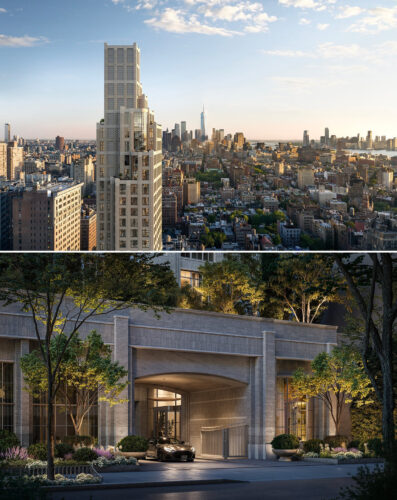
  • It’s Official: Parking Garage Will Become Luxury Condos

    NEW YORK CITY-DHA Capital LLC and its co-development partner Continental Properties have purchased 12 E. 13th St. in Manhattan. The property was sold for $32 million, or more than $700 per square foot. ABS Partners represented the sellers.

    Hertz Rental Car previously occupied the ground floor while the remainder of the building, which spans 45,032 square feet of space, was being used as a parking garage. The new owners plan to turn the structure into upscale condominiums and will likely create a mix of full-floor homes and duplexes, along with retail facilities, according to a release.

    “This is a highly desirable location where we intend to create large, super-luxury homes which will appeal to discriminating buyers,” says Steven Fisch, managing partner at Continental Properties, in the release.

    ”These types of homes are in very strong demand but short supply, particularly downtown,” adds Dan Hollander, managing principal of DHA. The team has engaged Cetra/Ruddy architects to design the conversion, which will not enlarge the building but will add several stories by demolishing part of the rear portion.

    Located on the southern side of East 13th Street, between University Place and Fifth Avenue, the property is close to Union Square. A similar building that was a parking garage at 66 East 11th Street was recently converted into a residential building offering luxury condos.

    Odell Real Estate represented the buyer. Hertz had vacated the building as its lease expired this past fall. The move allowed the building to be sold vacant, eliminating the uncertainty of a holdover tenant for potential buyers.

    Constructed in 1930 of brick, steel, and concrete, the building was most likely used as a horse stable in addition to a parking garage for cars, as evidenced by heating coils throughout the building, according to ABS director Adam Maxson in a separate release. The building also features two large car elevators.

    Recent construction activity in the Greenwich Village area helped create a strong demand for the building from a wide range of buyers that included both small local investors and large international investment groups, Maxson says in the release. The New School is currently constructing a 375,000-square-foot building just across the street and is scheduled to open in the fall of 2013. Also, a high-end 113-room boutique hotel, the Jade Hotel, is being built on West 13th Street.

    The seller was very happy with the purchase price, according to a press release issued by ABS. “The ABS team performed a stellar job navigating this complex transaction from start to finish,” says Darren Postel, one of the sellers, in the release. “ABS coordinated with a broad range of buyers to get this disposition executed. I could not be happier with the resulting sale at such an impressive number.”

    This is the latest in a series of deals for DHA Capital. The firm is in pre-development of a 300-unit rental property on Manhattan’s West Side. At 53 Pitt St. in Manhattan’s Lower East Side, DHA created and is now marketing 14 rental lofts. In Brooklyn, DHA purchased a 200,000-square-foot development site at 88 Richardson St. The property, which was approved for 230 rental units, was sold by DHA in July of 2012. The firm also acquired and sold a stalled luxury co-op in Harlem for repositioning as a rental.