The Golden Horse Awaits
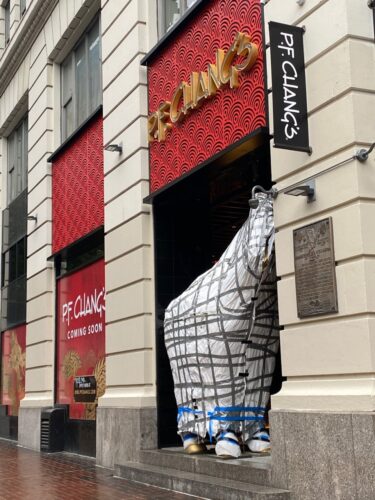
Amazing. The 10-foot-tall golden horse that will serve as decor in the upcoming PF Chang’s on University is still cooling its heels outside after more than six weeks. Why don’t they move it inside?

Next week (March 12 to March 16), Superstructure work will continue at 7th and 8th floor levels. Deliveries for the internal systems of the building have been ongoing and will continue, although they should not greatly affect the flow of pedestrian and road traffic.
The following week (March 19 to March 23), we will continue superstructure concrete and slabs on the 8th floor level. Deliveries for the internal systems of the building have been ongoing and will continue, although they should not greatly affect the flow of pedestrian and road traffic. We also have an approved After Hours Variance for Thursday and Friday in anticipation of a large concrete pour happening on one of those days.
This weekend the site will be open on Saturday, March 10th for superstructure related activities between the work hours of 7AM and 5PM as permitted by the City. To control noise levels within the site, work activities will be limited to the placement of formwork and concrete, plumbing and electrical work, rebar for concrete placement, using the crane and equipment to support all activities. Safety horns are used, and required by law, to coordinate lifting with the crane and to alert the workers of the danger overhead. We have directed the operators to limit the use of horns to one short sounding and to use the crane later in the day so as to avoid any excess noise.
In addition, tomorrow, Friday the 9th, we will be starting operations at 6am in anticipation of a large concrete pour and will more than likely, with notification of the Department of Buildings, be going later into the evening to finish. Also on the weekend of the 10th the 14th St. Con Ed Vault utility connection street work will continue per DOT Permit granted for weekends only.
Note that the entire western side of 3rd Ave. between 10th and 11th Streets save for the southernmost building has been bought up and is destined to meet the wrecking ball. The Greenwich Village Society for Historic Preservation says there are significant buildings with important stories on the block, but it seems unlikely the city will step in to stop redevelopment.
Gotham Bar & Grill, the longest-running high-end dining establishment in the neighborhood, is done.
According to Eater.com…
After 36 years — and one major, recent chef change — fine dining trailblazer Gotham Bar & Grill is closing. Saturday, March 14 will be its last night of service, according to an email sent to customers.
Restaurants across the city are closing temporarily as new measures to curb the coronavirus outbreak have led to declines in sales, but Gotham will not be reopening.
The closure follows a brief tenure from its new chef Victoria Blamey, who started leading the kitchen only last year — and was a significant change for the longtime regulars of the storied American fine dining restaurant. The previous chef, Alfred Portale, ran the kitchen for more than three decades and through its many accolades, including Michelin stars and James Beard Awards. He left to open his first solo restaurant, Portale, in Chelsea.
Blamey did not come into an easy situation. Much of the staff and the clientele were intensely loyal to Portale, who created dishes that became icons, like a riff on tuna tartare. He’d also been there for most of the restaurant’s tenure. Gotham opened in Greenwich Village in 1984, and he took over the large, white tablecloth establishment a year later.
Moreover, Gotham is a fine dining legend; its menu shaped what American fine dining looks like in New York. The pressure was on for Blamey, who was expected to bring a younger crowd to the restaurant. And under her, Gotham retained its three stars in the New York Times, with Pete Wells delighting in her additions to the menu.
“Love Armor”, a nationwide collaborative art project, will be on exhibition at the Brenda Taylor Gallery, 511 W. 25th St., NYC from May 14 until June 30th.
The Opening Reception is on Thursday, May 14th from 6:00 – 8:00 PM. I would love to greet my neighbors there that evening. All are welcome!

Allbirds, the shoes that Silicon Valley loves, signed an 8,000-square-foot lease deal with The Bromley Companies at 120-122 Fifth Avenue in the Flatiron District. The clothing and shoe company will be moving into the two-floor space at the Bromley building after The Gap moved out in the summer of 2021 after nearly 30 years. The retail space on West 17th Street and Fifth Avenue will serve as Allbirds’ U.S. flagship store. The sudden vacancy left by The Gap marked the first time in four decades that the retail location had been empty, having been home to the first Barnes & Noble superstore in the nation prior to the clothing store coming to the Flatiron.
Next week (June 10 to June 14), material and equipment deliveries and installation work will continue on all floors inside the building. We will be working on the new sidewalks around the building on 13th st. Additionally we will be working on the roofs of the building.
The following week (June 17 to June 21), material and equipment deliveries and installation work will continue on all floors as well as sidewalk work.
This weekend the site will be open on Saturday, June 8st for interior, roof, and sidewalk activities between the work hours of 7AM and 5PM as permitted by the City.