Nordstrom Rack
Certified OPEN

Union Square will host its first-ever Night Market by Urbanspace. Union Square is no stranger to Urbanspace, as the company is responsible for putting on the park’s beloved annual Holiday Market. However, this will be the first time Urbanspace will operate an open-air food market during summer nights.
The Union Square Night Market will run for four Thursdays, starting July 11th. More than 20 vendors will come together to bring New Yorkers some of the best bites in the city. It will all take place along the South Plaza of Union Square Park.
So whether you’re interested in grabbing something to eat on your summer commute home or planning a date night, the Union Square Night Market will serve as the perfect venue for either!
The sale of two units at Brack Capital Real Estate’s condominium conversion at 15 Union Square West may be set to shatter records for the sale of a single-family home on the square, the Corcoran Group’s Timothy Rothman told The Real Deal yesterday, since the new owner plans to combine them into one duplex spread. Rothman, a vice president at Corcoran on the Spiegelman team, represented a mystery foreign buyer in the deal for penthouse 11 and unit 10B at the building, which closed together yesterday for between $16 million and $17 million, he said, though he declined to give a specific price. The units were not on the market as a combination; their individual asking prices were $10.7 million and $6.5 million respectively. Rothman would not reveal the identity of the buyer due to a confidentiality agreement.
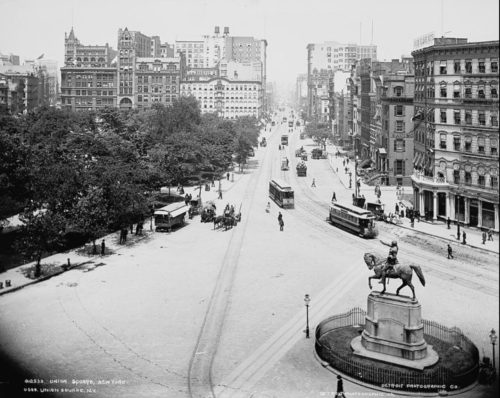
A fascinating photo of the good old days. The view is north up Union Square East to Park Ave. South, then known as 4th Avenue. Note that the George Washington statue used to reside at the intersection of 14th St. and 4th Ave.
Popeye’s and its famous chicken sandwich have landed on the corner of University Place and 14th St.

Carnival, the nightclub atop Bowlmor Lanes, will be transformed into a mini-golf nightclub called The Greenwich Village Country Club in October.
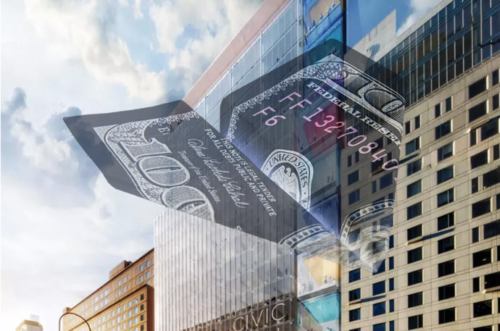 Demolition of the building which a PC Richard & Son store occupied at 124 E. 14th St. will begin immediately followed by construction of a 21-story, mixed-use office building that will house the new Union Square tech hub. Suffolk Construction will be the project’s general contractor.
RAL Development Services in a joint venture with Junius Real Estate Partners closed a $120 million construction loan from Bank OZK. Junius is a real estate investment unit of J.P. Morgan Private Bank, a division of J.P. Morgan Asset Management. Its focus is high yielding real estate equity and debt investments.
The developers also signed a 99-year ground lease with the New York City Economic Development Corporation. The New York Post reported the joint venture has agreed to the following arrangements: It made an up-front payment of $5 million and will not pay rent for the first three years during construction and lease-up. Afterwards the annual base rent will be $2.3 million for the first five years. The rent will then increase by 2% every year through the 30th year. Following this period, the rent will be subject to fair market resets. A spokesperson for RAL confirmed these financing terms with GlobeSt.com.
Last year, the city council approved the tech hub following New York City’s ULURP process. The steps were required to increase the as-of-right building height from 14 floors to 21 stories.
For 25 years, RAL will lease six of the floors to the non-profit Civic Hall, which will create a digital training center, a tech incubator, co-working spaces, event spaces and an urban food hall. RAL will lease the top 14 floors of the 21-story building at market rate. According to the RFP issued by NYCEDC, the tech hub is expected to create over 500 jobs in Union Square.
Josh Wein, financial director of RAL, says, “In addition to the multitude of benefits this development provides for the City and its workforce, which have been designed to promote job creation and growth in the technology sector, we’ll be creating the finest modern office building in Midtown South.”
Community groups including the Greenwich Village Society for Historic Preservation (now named Village Preservation) advocated for neighborhood protections to accompany approval of the tech hub. They supported the educational and public goals of the project but protested its development without inclusion of rezoning for surrounding neighborhood streets. They requested limited heights for new developments, removal of current incentives for hotel and dorm development, and the inclusion of affordable housing with new construction for a limited area around the center.
The neighborhood organizations expressed they were concerned about an eventual destruction of the unique character the Village—starting with its now being referred to as Midtown South.