A Refresher Course on the Metronome Wall Art
 from Gothamist.com
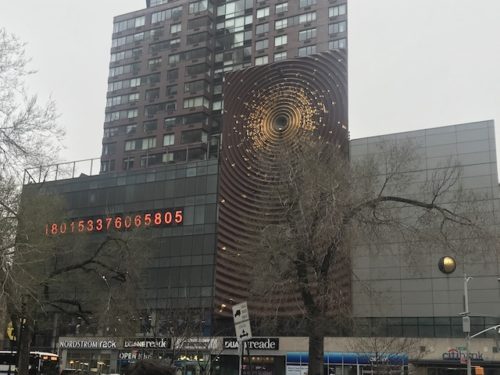
The Metronome, the hulking piece of public art omnisciently keeping time in Union Square, has been an object of both fascination and derision for twenty years. The work is meant to be a rumination on time and rituals, and features a massive rock, a whirring digital clock that means wildly different things depending on who you ask, and a hand from Union Square’s own equestrian statue of George Washington that points to its history.
Yet something seems to be off about the Metronome. As a tipster pointed out to Gothamist, the steam that was supposed to emerge from the center of the piece hasn’t worked in ages, it doesn’t seem to have been maintained in a while, and even its website is defunct.
That might be because the Metronome wasn’t ever finished, as Kristin Jones, the artist who created the piece along with Andrew Ginzel, tells Gothamist. It was always meant to be more than be a “gaping hole,” “void,” or “smoldering anus,” as it’s been called before. Jones says that the “dismissive and inadequate” upkeep from The Related Companies (the real estate company that owns the property) means the Metronome has never looked, or kept time, as they intended it to.
According to Jones, the piece, a nod to European clocks’ different mechanisms for telling time, originally was going to emit steam twice daily (at noon and midnight) along with bursts of sound. It barely has, if ever. She also notes that in spite of “periodic upgrades” to the numeral display, the clock was “never correct in the first place,” especially because the artists never saw it before it went up and it never had the flexible software it needed.
Jones knows that people seem baffled about what the numbers represent: They don’t, say, represent the national debt or the time left until the Earth implodes, and it is indeed a clock meant to be read left to right. (The left half, at least, which displays the time since midnight. The right half, which shows the time remaining until midnight, should be read right to left.)
Curiously, the Metronome, steam and all, is prominently displayed on Related Rentals’ website, currently hawking one-bedroom apartments at the Union Square locale for a starting price north of $5,500 monthly rent. (“Live Luxuriously in a Work of Art,” it reads.) Related did not reply to Gothamist’s request for comment.
The Metronome came about when Related approached the Municipal Art Fund in 1995, as The New York Times reported, about what to do with the building’s wall space. Eventually Related and the Public Art Fund held a competition where artists submitted proposals for the wall. Kristin Jones and Andrew Ginzel ended up getting the commission, and in 1999 the Metronome first began ticking along at Union Square.
Since then, the artists say, they haven’t had input, or knowledge, as to how the artwork is being maintained, if at all. Jones says she’d personally rather see the Metronome be torn down instead of continue in its current state. “Since they don’t [correspond with us] I’m not interested in seeing the light bulb in the hole where there’s no steam,” Jones says. “It doesn’t make any sense.”
Stephen Ross, the billionaire developer and chairman of Related, is responsible for Hudson Yards’ Vessel, the wastebasket-like stairway to…somewhere that owns your photos. Ross hasn’t been shy about his distaste for the piece Related had a hand in creating at One Union Square South. “It was a disaster,” he told The New Yorker last year. “That thing where the smoke comes out? Whatever the hell it is.”
“Union Square South was and is a machine for enrichment, as is so much of real estate development today often without sincere civic vision,” Jones and Ginzel wrote in a statement. “Witness Hudson Yards. If Mr. Ross maintains ‘The Vessel’ as he has Metronome, pity the public who must contend.”