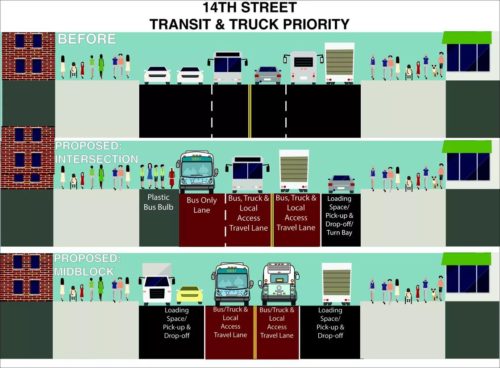
The Busway Is Back!!! On August 12!!!

A state Supreme Court judge has lifted a temporary order blocking the city from rolling out its bedeviled 14th Street busway pilot. Justice Eileen Rakoff ruled that the city’s Department of Transportation (DOT) complied with state law that mandates the agency study the impact of banning private cars on the surrounding residential streets.

After reviewing documents from the city and the coalition of Manhattan residents petitioning the busway, Rankoff lifted the temporary restraining order that blocked the pilot’s July launch on Tuesday. DOT spokesperson Alana Morales says the agency is beginning work “immediately” and will launch the busway on Monday, August 12.

Transit advocates who have long called for the pilot program, which was originally timed to launch with work on the L train’s Canarsie Tunnel, praised the ruling as a “huge victory.”

“When riders organize, the whole city wins,” says Danny Pearlstein with the Riders Alliance. “The 14th Street busway will provide faster and more reliable bus trips, saving precious time for tens of thousands of people who badly need it.”

Others charge that the ruling sets a key precedent for other streets where residents seek to use the courts to “circumvent the democratic process in order to preserve the car-dominant status quo”— such as Central Park West where members of an Upper West Side condo board are suing to block a bike lane, says Marco Conner, the deputy director of Transportation Alternatives.
Similar Posts

  • Times Article on Rising Co-op Costs

    Here, in its entirety, is a recent New York Times article about maintenance increases and transfer fees and how co-ops are currently suffering.


    Co-op Fees Go Through the Roof

    CO-OPS across the city have raised their maintenance charges by as much as 15 percent in recent months, and one of the main causes is rising property taxes.


    Board members and building managers say that while maintenance increases averaged only about 5 percent last year, many co-op buildings are now dealing with double-digit increases.


    “Operating costs have gone up, but property taxes have skyrocketed,” said John Janangelo, the president of Bellmarc Property Management, which manages about 50 apartment buildings in Manhattan. He said that taxes for some of his buildings had risen by as much as 35 percent in 2009. “It comes at the worst time,” he added, “because financially everyone is suffering. You don’t want to pass through these huge increases because people can’t afford them, but you have no choice.”


    Property taxes went up at the start of the year when the city eliminated a 7 percent homeowner tax cut initiated in 2007, when the city was on better financial footing. But there is another reason for the increase. Buildings whose property values soared in recent years are experiencing even bigger tax increases because the assessed values of their buildings have gone up.


    Co-op boards routinely challenge their assessments and if the city’s Tax Commission does not reduce the assessments, boards can appeal in court. Because the process is lengthy, a building that has received a series of big assessment increases may not get relief for years.


    “Assessments have gone up based on last year’s market,” said David Kuperberg, the president of Cooper Square Realty, which manages about 200 co-ops and condominiums. “And that’s like kicking homeowners while they’re down,” he added, noting that assessments often take a while to catch up to the market.


    Marty Hoffman, the board treasurer of a 106-unit co-op on West 89th Street, said that the assessed valuation of the building had gone up every year in the last five years for a total increase of 107 percent. The property tax bill has gone up 55 percent, from $369,000 in 2004 to $574,000 in 2009. Taxes this year alone went up by $83,000, or roughly $783 more annually for each tenant shareholder.


    Because each year’s higher assessment is phased in over a five-year period, Mr. Hoffman’s building faces at least four more years of hefty assessment increases as the increases that were issued when the market was booming continue to kick in. Mr. Hoffman said that even though the tentative assessment increase for 2009-10 was only 1 percent, the building may have another tax increase of about $83,000 next year because of the phase-in of previous assessment increases. “Aside from the run-up in oil prices,” he said, “nothing has gone up as fast as real estate taxes.”


    Mr. Hoffman said cheaper fuel was the only reason his building had been able to limit its annual maintenance fee increase to 7.2 percent. “If oil prices hadn’t dropped, we would have been faced with a 15 percent increase.”


    Some operating costs have risen, however. Richard Montanye, a partner with the accounting firm of Marin & Montanye in Uniondale on Long Island, which works with hundreds of buildings in the city, said that water and sewerage charges went up 14.5 percent last year. “Housing costs in the city in the past four to five years have far outpaced inflation,” he said.


    At the same time, some revenue sources have been drying up for many buildings. Those with commercial tenants, especially retail outlets, have been hit hard by the recession, with many tenants asking for rent reductions because their sales volume has dropped off significantly.

    “Retail tenants are all hurting,” said Richard Siegler, a lawyer who represents about 150 co-ops, “and they’re all coming to boards and asking for relief. If the economy improves, then a lot of this will go by the by, but if not, then boards will have to contemplate losing tenants, even though they’d rather not have a vacancy.”


    Buildings that in a stronger market relied on income from flip taxes — a sort of transfer fee for each sales transaction — may also struggle now that sales volume throughout the city has been reduced to a trickle.


    Robert Berliner’s 277-unit building on Sutton Place has a 2 percent flip tax for outside buyers, which he said “was a pretty significant source of revenue in 2006 and 2007.” The building had used that income to meet operating costs, but because there are now so few apartments changing hands in the building, the board has shifted its flip tax revenue into its reserve fund. “We’re trying to be more realistic and more conservative in dealing with our budget,” he said.


    Mr. Berliner said that because real estate taxes are so high for the building, the board may consider raising the flip tax to 3 percent. Property taxes were just under $3 million last year and represented the single largest expense in the building’s $7 million budget.


    Mr. Berliner, who is the co-op’s board treasurer, said that the city raised the building’s assessment by 25 percent in 2008, but the building challenged the increase and got it reduced to 10 percent.

    “But when you consider the state of the economy and what’s happening in real estate values,” he said, “how the city could have come up with any increase in assessed valuation is beyond me.”

  • Summer in the Square for August 15

    7:00 AM    Morning Running Club with Paragon Sports (Fitness)
    7:00 AM    Boot Camp with Circuit of Change (Fitness)
    8:00 AM    Yoga with Jivamukti (Fitness)
    10:00 AM  Yoga StoryTime with Karma Kids (Kids)
    11:00 AM  Hot Peas ‘n Butter (Kids)
    12:00 PM  New School Jazz (Music)
    5:00 PM    Performance by Peridance Contemporary Dance Company (Music)
    6:00 PM    Club Dance with Peridance (Dance)

  • What the L?

    A huge change of course for the proposed L train shutdown. Even though traffic on the northernmost block of University Place has been reversed, and even though the 13th St. bike lane is in full effect–and constantly blocked by trucks, of course–it now appears that none of this may have been necessary, and the upcoming 14th St. busway may not be implemented at all. Very very confusing. The MTA is ridiculous.