What’s Up with That Hole in the Ground One Block West?
Wondering what happened to the cute green building on 13th between 5th and 6th that housed Taste of Tokyo and La Dolce Vita? It’s gone. In its place will rise a small boutique hotel.

Replacing City Tavern at 22 East 13th St. will be All’Onda, which appears to be a high-end Italian spot focusing on seafood. The Chef is a veteran of both Morimoto and Ai Fiori.
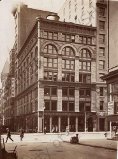
Our new neighbor Ann Roth tells us about this incredible image of the 14th St. building that she dug up:
“I found the image on the web, where someone was selling a hand-colored print of the 14th Street facade, from a magazine that dates to 1891. So it clearly dates to that year (or earlier), not 1899, as all the real estate ads say. I ordered it, and they immediately took it off their site, so I can’t send you the link, but I copied the image first, so I’ve attached it. I must say, I wish it still had the fancy spire. The architects were D’Oench & Simon. Albert D’Oench studied in New York and Stuttgart, and then worked for Robert Morris Hunt (who designed the Metropolitan Museum’s facade) for a while. He was the NY Inspector of Buildings for five years, which seems to have mainly involved fire safety. After that, he had a successful architectural partnership with Albert (or Bernard?) Simon, and they designed and built several fire stations in New York. D’Oench later married the mayor’s daughter. Clearly a man with good connections. The plan calls it a “store building,” built it for Mrs. Mary S. Van Beuren, who was the granddaughter and heir of Henry Spingler (who I think has a building on Union Square named after him). She lived nearby, on 14th Street, just west of 5th, and seems to have been a bit of a sharp customer, to judge from some of the legal tussles I found when I searched her name on Google.”
Permits have been filed to build a 12-story 29-unit building at 34 Union Square East. The proposed 124-foot-tall building will have 29,390 square feet of residential space and 1,555 square feet of commercial space. The site formerly held a TGIF restaurant and then the Spacious co-working space. It has been vacant for six years.
More changes are afoot for 14th St. in the coming years. Find out about the potential plans here.
Demolition of the building which a PC Richard & Son store occupied at 124 E. 14th St. will begin immediately followed by construction of a 21-story, mixed-use office building that will house the new Union Square tech hub. Suffolk Construction will be the project’s general contractor.
RAL Development Services in a joint venture with Junius Real Estate Partners closed a $120 million construction loan from Bank OZK. Junius is a real estate investment unit of J.P. Morgan Private Bank, a division of J.P. Morgan Asset Management. Its focus is high yielding real estate equity and debt investments.
The developers also signed a 99-year ground lease with the New York City Economic Development Corporation. The New York Post reported the joint venture has agreed to the following arrangements: It made an up-front payment of $5 million and will not pay rent for the first three years during construction and lease-up. Afterwards the annual base rent will be $2.3 million for the first five years. The rent will then increase by 2% every year through the 30th year. Following this period, the rent will be subject to fair market resets. A spokesperson for RAL confirmed these financing terms with GlobeSt.com.
Last year, the city council approved the tech hub following New York City’s ULURP process. The steps were required to increase the as-of-right building height from 14 floors to 21 stories.
For 25 years, RAL will lease six of the floors to the non-profit Civic Hall, which will create a digital training center, a tech incubator, co-working spaces, event spaces and an urban food hall. RAL will lease the top 14 floors of the 21-story building at market rate. According to the RFP issued by NYCEDC, the tech hub is expected to create over 500 jobs in Union Square.
Josh Wein, financial director of RAL, says, “In addition to the multitude of benefits this development provides for the City and its workforce, which have been designed to promote job creation and growth in the technology sector, we’ll be creating the finest modern office building in Midtown South.”
Community groups including the Greenwich Village Society for Historic Preservation (now named Village Preservation) advocated for neighborhood protections to accompany approval of the tech hub. They supported the educational and public goals of the project but protested its development without inclusion of rezoning for surrounding neighborhood streets. They requested limited heights for new developments, removal of current incentives for hotel and dorm development, and the inclusion of affordable housing with new construction for a limited area around the center.
The neighborhood organizations expressed they were concerned about an eventual destruction of the unique character the Village—starting with its now being referred to as Midtown South.