Farmer’s Market Sales Way Down

The New York Times reports:

This season’s inclement weather affected farmers’ markets as much as their crops, and customers lost early on never really came back. Just ask Michael Hurwitz, director of greenmarkets for the Council on the Environment of New York City.

“God, this was a tough year,” Mr. Hurwitz said. Market problems snowballed from the spring, when less produce than usual was available because of rain, cool weather and late planting on vendors’ farms. “That impacted customers coming back to market,” he said. “Spring is not for making money; it’s for getting customers in. Fall is for making money — and less people all season came to the markets.”

Those all-important weekends, including the two biggest market weekends of the season in mid-October, were rainy, and that meant fewer shoppers, Mr. Hurwitz said. At the largest market, in Union Square, business was off by as much as 40 percent this season. The economic crisis compounded the low turnout, though on the bright side, he said, it generally kept vendors from raising prices.

But farmers like John Glebocki had little choice. Mr. Glebocki is an Orange County farmer who sells his produce exclusively at 22 farmers’ markets, most of them in the New York City system. He figures he lost nearly 50 percent of his 80 acres of mixed vegetables, but he has faith in his customers. “People understand it’s a low production year,” he said, “and if we have to tack on another quarter a pound.”
Similar Posts

  • The Villager Writes About Union Sq.

    From the current issue of The Villager:

    When Danny Meyer opened the Union Square Cafe 24 years ago, area rents hovered around $8 per square foot. Today comparable space could rent for up to $400 per square foot.

    The business dilemma of astronomical rents was one of the issues under consideration on Mon., Nov. 10, at the Union Square Partnership Fall Forum titled, “Spotlight on Commercial Diversity in Union Square.”

    A panel of four experts joined moderator William H. Kelley, the Partnership’s director of economic development, in a roundtable discussion of the area’s commercial landscape.

    More than 75 residents and local business owners attended the forum in the Union Square Ballroom, in what one participant described as an attempt to “think outside the box and look forward.”

    Kelley explained the motivation behind the forum:

    “In its heyday, Union Square had this wonderful gathering of mom-and-pop businesses,” he told The Villager. “Recently, the area has become an international gathering of businesses.”

    Forum participants debated if this evolution was an inevitable result of growth or if there were there any tools the Union Square area or even city government could employ to create a more stable mix of large and small businesses.

    “I think Union Square is fascinating,” said panelist Larisa Ortiz, of Larisa Ortiz Associates and a co-author of “Real Estate Redevelopment & Reuse.” “It’s a model and a template that other cities have followed,” she said, noting the presence of iconic restaurants and the Greenmarket.

    According to an examination of gentrification trends by New York University’s Furman Center for Real Estate and Urban Policy, the number of businesses in the Union Square area rose almost 20 percent from 1990 to 2000, and have grown an additional 8 percent since 2000.

    Of those businesses, 11 percent represent food services and “accommodations.” The largest number of retail businesses — 23 percent — are clothing and accessory stores.

    Ortiz was concerned how the neighborhood could maintain its character when park-fronting property is privately owned and rents are set by overheated market forces.

    “Let’s help interesting speciality business and restaurant spaces on the side streets,” she suggested.

    To gauge interest in topics for the forum, the Partnership sent out a questionnaire in September to more than 3,500 local residents and businesses. A question asked what the most important issue facing Union Square is.

    The survey drew almost 300 responses. Topping the list of concerns, 43 percent of respondents said pedestrian congestion and safety are of primary importance. Another 24 percent believed addressing the neighborhood’s changing character was paramount. Six percent saw completing reconstruction of the square’s north end as important.

  • New Laundry Machines, the Details

    Sebco Laundry will no longer be accepting pre-paid cards to use the machines in our buildings. They are switching to an app which is called My Magic Pass. Residents will need to download the app and use the site code 7–11 EAST 13TH STREET.

    You will be able to pay for use of the machines by using the app. Directions on how to use the app are posted in each laundry room.

    If residents have money on their current cards Damian will provide an envelope to mail to Sebco to get refunded. Please let us know if you need an envelope. THere are also envelopes available in the laundry rooms.

  • New Shopping Opportunities in the ‘Hood

    CAMP | 110 Fifth Avenue
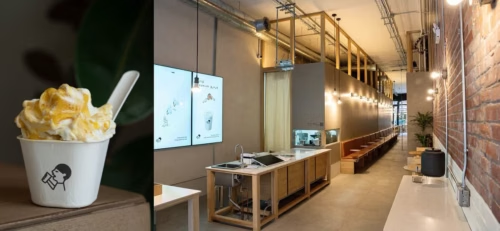
    Camp is now in session! Bring the whole crew for this family fun experience – it’s a store, a play space and a canteen store all in one! Stop in on Fifth Avenue for activities in the campitheater, rotating events, and only-in-usq treats from Milk Bar.

    Gupshup | 115 East 18th Street
    From Bombay to the Big Apple, this dramatic new Indian hangout eatery is bringing a 70’s flair to Union Square. Step into this decked-out space to try Indian fusion dishes like lamb shank with rogan josh sauce and roasted bone marrow with 5 spice naan.

    Filson | 876 Broadway
    Established over 120 years ago, Filson is the leading outfitter and manufacturer in high quality outdoor goods. At their new flagship NYC location on Broadway, find camping, hunting and climbing gear, all with a guaranteed lifetime warranty.

  • Goodbye, P.C. Richard

    From Crain’s New York Business:

    The P.C. Richard & Son store near Union Square is going the way of the cathode ray television set and VCRs.

    The city’s Economic Development Corp. has announced a request for proposals to redevelop a city-owned site at 124 E. 14th St. that for the past 19 years has been home to a two-level building occupied by the electronics and appliance store.

    The EDC is encouraging developers to pitch projects that include new office space for booming industries in the neighborhood, such as technology and creative businesses. According to the city’s guidelines, the development could provide fledgling companies with the space to get started and also a location for young but established firms to transition from incubator and co-working spaces that have sprouted around the city into their own digs.

    Proposals may also include residential space, although a spokesman for the city said the EDC’s goal is an office-focused development. Current zoning on the site, however, would seem to encourage a residential component. About 140,000 square feet of housing can be built at the address versus about 93,00 square feet of commercial space. A project could be a blend of the two.

    Midtown South has become the city’s hottest office market, with space in the vicinity of Union Square especially popular for its access to transit, shopping, restaurants and tony residential neighborhoods.

    “The current site of the PC Richard store will serve as a new tech hub in Union Square, capitalizing on the academic and transit advantages offered by the neighborhood and its proximity to the Flatiron district,” said Maria Torres-Springer, president of the EDC, in a statement. “This is just one example of how we are finding creative uses for the assets we have in a city where space is harder and harder to come by.”

    Bids for the property are due by February, the spokesman said, which is the same month that P.C. Richard’s lease is set to expire.