Legal Weed Coming to East 13th St.

Manhattan’s second legal marijuana store will open in February at the site of the former Chase bank on the corner of Broadway and 13th Street.

When it opens  it will donate 51% of its revenues to the Doe Fund, which helps vulnerable populations in New York City with work, housing, and access to continuing education, career training, and counseling.

The Doe Fund was one of more than a dozen NGOs and businesses to get a dispensary license in November, indicating that the city is poised to see an influx of legal recreational dispensaries.

The 5,000-square-foot area will be a “higher velocity” store, which means it will be designed to accommodate a larger volume of consumers effortlessly, whether they come in to pick up a pre-order or speak with a budtender.

Similar Posts

  • Demolition on West 17/18th Streets for…Condos?

    From DNAinfo:

    A developer’s plans to knock down two buildings in an historic district near Union Square to make room for new apartment towers, was shot down by the local community board, who say the integrity of the neighborhood and the retail options there should be preserved. Developer C.A. White wants to tear down two buildings at 21 W. 17th St. and 16 W. 18th St. to build 13- and 11-story apartment buildings in their place. The current buildings, which are significantly shorter, are occupied by a Rent a Runway shop and an empty storefront, formerly home to the restaurant BLT. They’re also a part of the Ladies Mile Historic District, and would ultimately need approval from the Landmark Preservation Commission to be altered.

    extralarge

  • Park Arrests Way Up

    Something has gone wrong in Union Square Park this summer. Complaints about illegal behavior, drug use, and vagrancy have led to a 320% increase in police citations. Now the police are patrolling much mor aggressively, as are hired security teams from the Union Square BID.

  • Union Sq. Pedestrian Zone Declared a Success

    According to this NY Times story:

    The city’s Department of Transportation has declared its pedestrian plaza on the north side of Union Square, the fourth such major street revamping along Broadway, an out-and-out success, despite some early qualms from residents.

    The redesign, implemented about a year ago, banned most cars from the block of Broadway north of Union Square, between 17th and 18th Streets, and closed a traffic lane on Union Square North. Tables and chairs were placed on the closed-off areas, and the neighborhood’s green market was able to expand.

    The idea was to simplify a particularly tricky intersection where a confusing jumble of traffic signals and two-directional car lanes had resulted in a string of pedestrian injuries.

    But the plan initially met stiff opposition from residents and businesses in the area, who complained about traffic jams on residential streets and problems for delivery trucks. A raucous community board meeting resulted in outcry and a mass walkout from protesters.

    One year later, the city’s traffic engineers say that the improvements, for cars and pedestrians alike, have been palpable. (Here’s a pdf link to the report.) And no businesses or store managers appear to have registered complaints with local officials.

    Radar samples found that about 12 percent of cars on Broadway between 20th and 19th Streets were now exceeding the 30 mile-per-hour speed limit, down from 28 percent of cars before the changes. Pedestrians can navigate a shorter crosswalk at the north end of Union Square, and they are waiting a shorter time for a “walk” signal.

    Bicycle riders, who benefited from an additional protected lane along East 17th Street, also appear to be enjoying the changes: the agency found a 16 percent jump in cyclists in the area on weekdays, and a 33 percent increase on weekends.

    Still, automobile drivers now appear to be avoiding the stretch of Broadway south of Madison Square, where the street was reduced to a single lane of car traffic and the direct car connection through Union Square was severed.

    The number of cars traveling on that stretch has dropped by about half since the plaza was installed, the report said. Some of those drivers may be choosing to take Fifth Avenue or Park Avenue South for southbound trips through the area, slightly slowing those routes. The average speed of taxis along Fifth Avenue fell slightly after the plaza was installed, and southbound trips on Park Avenue South took longer.

    But the Transportation Department noted that average speed along West 18th Street, where residents were most fearful of jam-ups, rose by about 14 percent, to 7 m.p.h. from 6 m.p.h. And average speeds on Park Avenue South stayed relatively unchanged.

    The Union Square Partnership, the neighborhood’s economic development group, conducted a door-to-door survey of area businesses, and 60 percent of those who responded said they were happy with the new traffic configuration. About 35 percent had no opinion.

    Still to be determined: some illegal left turns at the always-dangerous perpendicular intersection of Union Square West and 14th Street. (Initially, the agency had hoped to close off parts of Union Square West entirely, but some businesses objected.) The city said it was working on new street adjustments to tackle the problem.

  • Mysterious Clock Now Counts Down to Our Doom

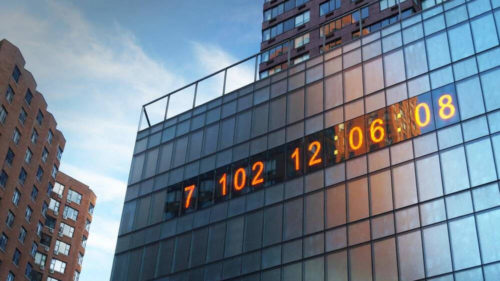
    In honor of Climate Week, a coalition of scientists and activists reset the digital clock with red numbers seen on the side of a building in Union Square and changed it into a “ClimateClock.” The numbers now count down the years, days, hours, minutes and seconds the Earth has left to take action to stop global warming from going over 1.5°C more than the pre-industrial levels.

    According to the organization, who aims to put the countdown clock in cities across the world, the clock’s calculation is based on the world’s current rates of emissions and the amount of CO2 that can still be released into the atmosphere. The clock simply counts down to when the “carbon budget” runs out. If the world manages to lower its emissions, more time will be left on the clock.

    The clock is based on the carbon clock made by the Mercator Research Institute on Global Commons and Climate Change (MCC) which uses data from the recent IPCC Special Report on Global Warming of 1.5°C, ClimateClock says.

    The artists responsible for putting up the clock in Manhattan told the New York Times in an interview that the display will be up until the end of Climate Week, Sept. 27. Artists Gan Golan and Andrew Boyd also told the paper that they created a mobile Climate Clock for Swedish climate activist Greta Thunberg last year before her appearance at the UN Climate Action Summit.

    With the backdrop of recent wildfires and hurricanes, which scientists say show how climate change is magnifying the extremes in weather, protests for climate action are expected all over the world on Friday.

  • A Sad Farewell to Bowlmor’s Friendly Face

    From The New York Times’ Metropolitan Diary:

    Greenwich Village’s Bowlmor Lanes on University Place, open since 1938 and one of the longest continuously running bowling alleys on the East Coast, shut its doors on Monday to make way for new condominiums.

    Much more than the disappearance of another landmark is the loss of Mark Braunreuther, Bowlmor’s man at the door for the past 16 years: benevolent minder, gentleman greeter, peacekeeper on the rowdy corner between Bar 13 and Bowlmor, an area labeled by one resident as the intersection between “Bucket” and “Blood.” On weekends, residents regularly awaken to police sirens and find violent traces splattered on early-morning sidewalks. Mark was always deep in the fray. His judiciousness was the reason so many revelers went home unharmed.

    Mark B. was the mayor of University Place. He knew most of us, and all of our pets, by name. Last summer he tended corn seeds in the tree bed out front. Just seeing those struggling cornstalks made one glad for summer. This coming season, he was planning some tomatoes.

    Mark regularly brought my husband and me cake from his favorite Queens bakery. The box always included biscuits for our dog. We reciprocated with Carolina barbecue sauce.

    Mark lost everything in Hurricane Sandy — his entire apartment and his car. His bosses replaced the car so he could get in from Far Rockaway. And when our Bowlmor closed for good, they promised a good position at their Chelsea Piers location. Mark was very grateful but he admitted he’d miss our neighborhood.

    Mark died suddenly a few weeks before Bowlmor Lanes closed its doors forever.

    Rest in peace, brave knight. I, for one, will miss you long after a bowling alley is a distant memory.