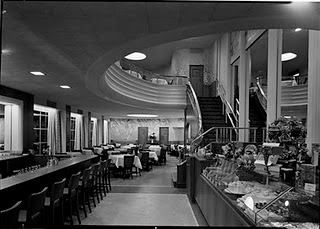
61 Fifth Avenue, Remembered

Here’s a great look back at the former Schraffts Restaurant which stood on the southeast corner of 5th and 13th before it morphed into clubs in the 80s and then delis in the 90s before burning down a few years ago. Now, of course, a 10-story condo is rising on the site. But enjoy these memories of the good old days.
Similar Posts

  • Chat N Chew Goes Italian

    Comfort food joint Chat ‘n Chew shut its doors this week after 22 years in the neighborhood, but the owner plans to reopen it as an Italian restaurant.

    The diner-style eatery at 10 E. 16th St. near Fifth Avenue will relaunch in two weeks as Little Sal’s, said Ethan Silverman, son of owner Andrew Silverman.

    “[Chat ‘n Chew] lost some of it’s energy, and now we’re getting it back,” Ethan Silverman said. “It’s going to be a Chat ‘n Chew on steroids. It’ll have traditional Italian food like chicken parm, eggplant parm and pastas.”

    Silverman compared the concept of Little Sal’s to New York City restaurants like Sauce and Parm, where it’s “casual and family oriented — selling wine by the glass and not the bottle,” he said.

    Andrew Silverman also co-owns Flatiron’s City Crab and Barbounia restaurants.

    Little Sal’s will open as a pop-up in two weeks for a test run, and may remain open permanently depending on how well it does, Silverman said.

    As for Chat ‘n Chew’s abrupt closure, Silverman said the team had known that they would be closing for a while, but hadn’t made it public.

    “If people took a look at the place recently, they’d see that the staff was slowly kind of diminishing,” Silverman said.

    “We’ve been in Union Square for a while, and we’re going to come back with energy,” he continued. “But [the concept] will be [in] keeping with the people who work and live in the neighborhood.”

  • Barry Benepe, The Father of NYC’s Farmer’s Markets, Had Died

    From the NY Times:

    Barry Benepe, an urban planner who in 1976 conceived of inviting farmers to truck their ripe tomatoes, peppery arugula and fresh corn to forlorn patches of New York City, delivering bustling markets and excitement to the city along with flavorful and healthy food, died on Wednesday at his home in Saugerties, N.Y., in the Hudson Valley. He was 96.

    New York’s popular Greenmarkets, the largest farmers’ market network in the country, helped start a national farm-to-table culinary movement. They are credited with saving thousands of acres of farmland in the region from development and reviving urban neighborhoods. Renowned chefs who discovered the bounties of fresh strawberries and zucchini blossoms were soon buying much of their seasonal produce from Greenmarket stalls.

    Mr. Benepe (pronounced BEN-eh-pea) raised grant money and worked the city bureaucracy to organize the first market with a colleague, Robert A. Lewis, whose role was to recruit wary farmers. During a decade of high crime and urban decay in New York, farmers feared that whatever money they made would be boosted before they escaped the city.

    Instead, the first Greenmarket — which kicked off in Manhattan in the summer of 1976 at East 59th Street and Second Avenue with a handful of upstate growers offering an open-air cornucopia — was an immediate success.

    “It could not have been a better location,” between two popular department stores, Mr. Benepe recalled in a 2022 interview with On Hand, a foodie newsletter. “We were halfway between Bloomingdale’s and Alexander’s. We were in the passage between the two, so you had to stop.”

    By contrast, the Union Square market — today the rock star of Greenmarkets — did not have a promising start. It opened later that year, but for weeks nobody came to visit the farmers who had set up in a park strewn with litter and known for drug sales. Mr. Benepe personally watered crab apple trees on the site.

    The market went on to anchor a neighborhood rebirth that included Danny Meyer’s Union Square Café and a multiyear improvement plan by the Parks Department.

    “We both loved the idea of the city benefiting from the revival of a European kind of lifestyle,” Mr. Lewis, whom Mr. Benepe hired in 1975 for his one-man planning firm, said in an interview. “He’d spent so much time in France and England. The daily shopping at the market. The fresh bread — this is Barry, a romantic.”