NY Times Talks Up Union Square
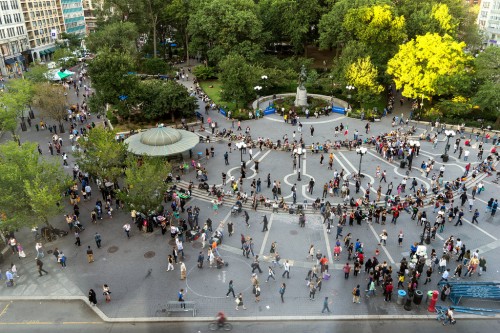 Did you catch the NY Times raving about Union Square? Good for real estate values.

Did you catch the NY Times raving about Union Square? Good for real estate values.
Next week (January 30 to February 3), Superstructure work will continue at and 3rd, 4th and 5th floor levels.
The following week (February 6 to February 10), we will continue superstructure concrete and slabs on 4th and 5th floor levels.
This weekend the site will be open on Saturday, January 28th for superstructure related activities between the work hours of 7AM and 5PM as permitted by the City. To control noise levels within the site, work activities will be limited to the placement of formwork and concrete, plumbing and electrical work, rebar for concrete placement, using the crane and equipment to support all activities. Safety horns are used, and required by law, to coordinate lifting with the crane and to alert the workers of the danger overhead. We have directed the operators to limit the use of horns to one short sounding and to use the crane later in the day so as to avoid any excess noise.
In addition to the normal work this Saturday we will be disassembling the small crane and removing it from the site. During the demobilization 13th St. will be closed as well as some lanes on 5th Ave. Pedestrian traffic will also be temporarily closed on the east side of 5th ave. for safety.
Please do not hesitate to contact me if you have any concerns or questions. Thank you
Jane R. Crotty
Senior Vice President
George Arzt Communications, Inc.
123 William Street, 22nd Fl.
New York, NY 10038
T (212) 608-0333

Construction of the glassy turtle shell-shaped dome on top of Union Square’s landmarked Tammany Hall building is officially underway. The building at 44 Union Square, formerly home to NYC’s Democratic party machine, is being transformed into modern office and retail space. New construction photos provided to 6sqft show the start of the unconventional dome’s installation, with the diagonally intersecting glass and steel now visible from the street. The political organization of Tammany Hall formed in New York City in the late 18th century and helped Democrats control city and state politics for decades. After a few different headquarter locations, the society landed in a building on East 17th Street and Union Square. The International Ladies Garment Workers Union bought the building in 1943. Other tenants have included the New York Film Academy and the Union Square Theatre. Designed by BKSK Architects, the redevelopment project consists of a gut renovation and the addition of four stories of retail space in the building’s base, with three levels of office space on the upper levels, including inside the dome. The architects designed the glass dome as an ode to the turtle which Lenape Chief Tamanend stands upon on a Philadelphia statue. Tammany Hall was named after the leader. According to the firm, the dome is “meant to be both evocative and respectful of the building’s past while also bringing architectural spectacle to this rather staid corner of Union Square.” BKSK first submitted plans to revamp the historic building in 2014. After the project was approved a year later by the Landmarks Preservation Commission, developer Reading International secured $57.5 million in financing. Renovations began in 2016. The dome features a framework of intersecting glass and steel, manufactured by German-based firm Gartner. There’s no doubt the top floor will not only be drenched in natural light but also offer unique views of Union Square and beyond.
PLEASE READ: YOU MAY HAVE RECEIVED A LETTER FROM THE CITY IN ERROR:
Tens-of-thousands of city residents eligible for a popular condo and co-op tax break have received letters from the city incorrectly stating that they no longer qualify, according to city civic and co-op board leaders.
Late last week, co-op and condo owners began receiving the letter from the city Department of Finance stating that a revamped condo and co-op tax abatement bill passed by the Legislature in January meant they could not collect it. “Our records show that this unit is not your primary residence, so your abatement will be phased out,” the letter states. The new legislation only allows owners to claim the tax break on their primary residence, and no longer allows the break on secondary homes.
The problem was that many people received the letter at their primary residence—which is indeed still eligible for the full break, according to Warren Schreiber, co-president of the Co-Op and Condo Council in northeast Queens. Mr. Schreiber said in his own co-op of about 200 residences, some 45 people had received the letters— about 35 of whom actually count those units as their primary residence. That could make a difference of about $1,000 per unit on upcoming bills if not corrected, he said.
“Some people have been in their homes, 20, 30 or 40 years and are getting these letters,” said Mr. Schreiber. “I think what happened is that the Department of Finance’s records are out of date, but it’s causing a lot of confusion and chaos.”
Nearly two years ago, Finance Commissioner David Frankel acknowledged the department had erred on 15,000 property bills the city mailed that July because of a “computer glitch.”
But in this case, a Department of Finance spokesman said the agency had used available data to determine which of the city’s 360,000 condo and co-ops would qualify for the abatement, and automatically enrolled 230,000 of them. In instances where there was not enough information, the agency sent out 130,000 of the letters to homeowners saying were not eligible for the tax break.
Mary Ann Rothman, the executive director of the Council of New York Cooperatives & Condominiums, said she too had been contacted by several people who have received the letters—despite simultaneously receiving the state’s STAR tax rebate on the same property, which can only be claimed at one’s primary residence.
Still, she defended the city Department of Finance, arguing that it was simply sending the letters out to the large number of co-op and condo owners in an effort to make sure the city’s records were correct under the revamped program.
“This is making people nervous, but you have to remember that this is a total change in the way that the abatement is administered,” she said.
The letters the city sent to co-op owners directs them to send a form to an address in Maplewood, N.J., verifying that they are in fact receiving the abatement on their primary residence. The form is due on April 1, and city tax bills reflecting whether the abatement will still be granted will go out in June. Those no longer eligible for the abatement would retroactively have to pay 50% of the normal break in July, and would stop getting it altogether in July 2014.
But Mr. Schreiber said he was concerned that elderly property owners, those with disabilities or those who live elsewhere for the winter, would have their tax break incorrectly pulled.
The parameters of the new condo and co-op bill were originally hashed out in June 2012, but Gov. Andrew Cuomo at that time decided not to issue a message of necessity circumventing a three-day waiting period to pass it before the end of the legislative session. As a result, the city Department of Finance decided essentially not to collect hiked condo and co-op taxes under the expectation that the legislature would eventually pass the agreed-upon bill—which it finally did this January.
The revamped program offers greater benefits to middle-class owners, raising their tax abatements from 17.5% to, 26.5% next year and 28% in 2015 for properties whose average assessed value is less than $50,000. Units valued at more than $60,000 would get abatements of 17.5% over the next three years. Other previous aspects of the program—including one that allowed real estate speculators to claim abatement for secondary residences—were eliminated.
The retail retreat continues, with the departure of American Eagle from Union Square West.
 Now, of course, it is apartments, but it was built as the home of Fairchild Publishing.
Read this fun and interesting New Yorker article about artists who get together in our nearby smelly Taco Bell.