
Mashable Loves Union Square

The Union Square area is becoming a high-tech hotbed. Mashable CEO Pete Cashmore was interviewed about why he brought his company here:

Last September, Pete Cashmore moved Mashable’s headquarters from 23rd Street to the heart of Union Square. What he found when he arrived was a climate he says is perfect for startups.

Factors that play into the business climate he found just a few blocks south of Mashable’s previous location include a fertile history of innovation, access to creative talent, and proven professionals. But in the end, what’s most attractive to Cashmore is good, old-fashioned, face-to-face interactions.

“Union Square has always been a meeting place, where people come together and share ideas,” Cashmore told me on Tuesday at an event at the British Residence of New York. “And now with it becoming a real hub of innovation it is a great place to be.”

Now employing about 140 people, Mashable’s offices occupy two floors on Fifth Avenue and 17th Street.

No doubt, part of what Cashmore found there was nurtured by venture capital firm, Union Square Ventures (USV), which was founded in 2004 and now manages $1 billion in assets across six funds. USV’s previous investment in New York City-based companies include Etsy (Nasdaq: ESTY), Tumblr (acquired by Yahoo for $1.1 billion), and MongoDB, which has raised $311 million venture capital.

But over the past year, the number of significant real-estate investments in Union Square shows that it’s much more than just Fred Wilson’s influence at work in the area.

The top three lease transactions of 2015 are BuzzFeed, which now occupies 194,000 square feet at 225 Park Avenue South, Gawker Media, which is in 58,900 square feet at 114 Fifth Avenue, and First Look Media in 58,206 square feet at the same location, according to a Union Square Partnership report published in May. New and expanded office tenants in Union Square also include Dropbox, Adobe Systems Inc. Hulu, Lippe Taylor, Pop2Life, Capital One Labs, The New Republic, and Compass.

The top sector in the area is “professional, scientific, and tech services,” with 1,514 firms, followed by retail with 1,393 firms. Among the top firms by number of employees is J. Crew, listed with 3,800 employees and Tory Burch, with 1,800. In total, 9,700 businesses are located within the half-mile radius of Union Square considered by the report, employing over 153,000 people.

What’s attracting all this talent? Not the rent. According to a May report by San Francisco-based real estate analytics firm Zumper, only two neighborhoods are more expensive than Greenwich Village, where Union Square technically is designated as being located. Average rent for a one bedroom apartment costs $3,850. In Chelsea it’s $3,920, and in Tribeca, $4,450. According to the same report, New York City was the second most expensive city in the United States, just behind San Francisco.

In an interview Wednesday, Union Square Partnerships managing director Scott Hobbs ventured his own theory as to why so many innovative companies are moving to his neighborhood. “The biggest reason is it’s a transportation hub,” he said. “You’ve got Williamsburg for creatives across the river, and midtown for business.” Trains that depart Union Square Station are the N, R, Q, 4, 5, 6, and L.

As for Cashmore, his explanation is much more simple. “What’s really great about Union Square is you can go get a coffee and bump into someone doing something interesting in tech,” he said.
Similar Posts

  • Capital One Bank Cafe to Open at 14th/Bway

    Later this year, Capital One will open a new banking concept in New York City’s Union Square with a large café, operated by Peet’s Coffee, and an upstairs lounge that will function as a communal work space, complete with free Wi-Fi.

    Not unlike the Apple Store, the bank will serve customers with mobile tellers, who will have iPads on which they will handle transactions, rather than the standard glass window setup.

    The bank already operates a number of Capital One 360 Cafés, where customers are invited to enjoy coffee while they learn about ways to manage their finances, but the upcoming location takes a page from the rising popularity of communal office spaces, which are increasingly common in New York City.

    The basement of the café at 853 Broadway will be used as a classroom. Customers can take courses on mortgage financing and other topics.

    The elevated café concept is expected to expand beyond Union Square; the bank is reportedly already looking to open a location in the SoHo neighborhood, but a deal has not yet been made.

  • 15 Union Sq. Park West: Gorgeous, Pricey

    Your reporter visited an open house at 15 Union Square West. The verdict: the ceilings are incredibly high and the windows are huge. Fixtures are fantastic although overdesigned for someone with more sedate tastes. The most interesting feature: an interior atrium complete with 19th century ironwork and a skylight that will be restored. Incredible to see it. The big problem: these apartments are insanely expensive.

  • New Asian Restaurant Nearby

    Various sources report on the opening of Hea, the new eatery from Friend House owner Joe Ngai. They write: “Chef Heng Meng Kong (Penang) indulges his Malaysian background with dishes like green curry with market vegetables and skate wing grilled in banana leaves. Hea morphs into a lounge at night, where drinkers can sample elixirs such as a blend of plummy spiced rum, lemon juice and seltzer, or vodka mixed with Calpico (a Japanese soft drink) and yuzu.” 145 E. 13th Street, 212-982-1688.

  • A Refresher Course on the Metronome Wall Art

    from Gothamist.com

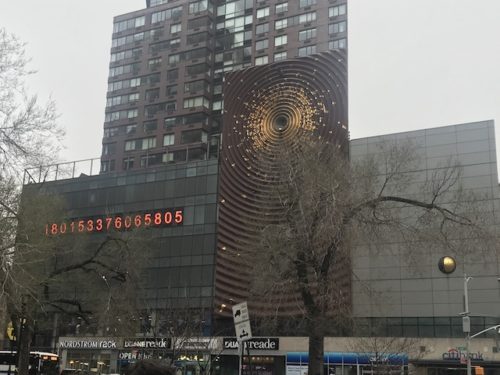
    The Metronome, the hulking piece of public art omnisciently keeping time in Union Square, has been an object of both fascination and derision for twenty years. The work is meant to be a rumination on time and rituals, and features a massive rock, a whirring digital clock that means wildly different things depending on who you ask, and a hand from Union Square’s own equestrian statue of George Washington that points to its history.

    Yet something seems to be off about the Metronome. As a tipster pointed out to Gothamist, the steam that was supposed to emerge from the center of the piece hasn’t worked in ages, it doesn’t seem to have been maintained in a while, and even its website is defunct.

    That might be because the Metronome wasn’t ever finished, as Kristin Jones, the artist who created the piece along with Andrew Ginzel, tells Gothamist. It was always meant to be more than be a “gaping hole,” “void,” or “smoldering anus,” as it’s been called before. Jones says that the “dismissive and inadequate” upkeep from The Related Companies (the real estate company that owns the property) means the Metronome has never looked, or kept time, as they intended it to.

    According to Jones, the piece, a nod to European clocks’ different mechanisms for telling time, originally was going to emit steam twice daily (at noon and midnight) along with bursts of sound. It barely has, if ever. She also notes that in spite of “periodic upgrades” to the numeral display, the clock was “never correct in the first place,” especially because the artists never saw it before it went up and it never had the flexible software it needed.

    Jones knows that people seem baffled about what the numbers represent: They don’t, say, represent the national debt or the time left until the Earth implodes, and it is indeed a clock meant to be read left to right. (The left half, at least, which displays the time since midnight. The right half, which shows the time remaining until midnight, should be read right to left.)

    Curiously, the Metronome, steam and all, is prominently displayed on Related Rentals’ website, currently hawking one-bedroom apartments at the Union Square locale for a starting price north of $5,500 monthly rent. (“Live Luxuriously in a Work of Art,” it reads.) Related did not reply to Gothamist’s request for comment.

    The Metronome came about when Related approached the Municipal Art Fund in 1995, as The New York Times reported, about what to do with the building’s wall space. Eventually Related and the Public Art Fund held a competition where artists submitted proposals for the wall. Kristin Jones and Andrew Ginzel ended up getting the commission, and in 1999 the Metronome first began ticking along at Union Square.

    Since then, the artists say, they haven’t had input, or knowledge, as to how the artwork is being maintained, if at all. Jones says she’d personally rather see the Metronome be torn down instead of continue in its current state. “Since they don’t [correspond with us] I’m not interested in seeing the light bulb in the hole where there’s no steam,” Jones says. “It doesn’t make any sense.”

    Stephen Ross, the billionaire developer and chairman of Related, is responsible for Hudson Yards’ Vessel, the wastebasket-like stairway to…somewhere that owns your photos. Ross hasn’t been shy about his distaste for the piece Related had a hand in creating at One Union Square South. “It was a disaster,” he told The New Yorker last year. “That thing where the smoke comes out? Whatever the hell it is.”

    “Union Square South was and is a machine for enrichment, as is so much of real estate development today often without sincere civic vision,” Jones and Ginzel wrote in a statement. “Witness Hudson Yards. If Mr. Ross maintains ‘The Vessel’ as he has Metronome, pity the public who must contend.”