Downstairs: Crab House

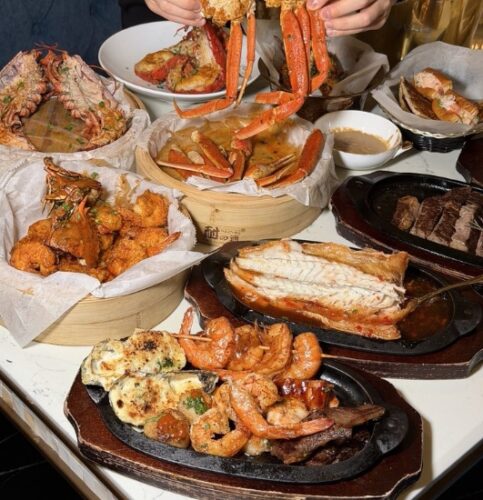
Reyna restaurant has been officially replaced by the upcoming Crab House Union Square. Here’s an article:

All-you-can-eat seafood chain Crab House has secured its fourth New York City location at 11 East 13th Street in Manhattan’s Greenwich Village neighborhood, Commercial Observer has learned. The 6,500-square-foot space between Fifth Avenue and University Place went fishing for a new proprietor in early August, following the departure of Mediterranean tapas restaurant Reyna New York. The lease was signed with a monthly asking rent of $38,500. Crab House operates two other Manhattan locations, at 218 West 40th Street in Times Square and 135 East 55th Street in Midtown East, as well as a spot in  Brooklyn’s Coney Island at 1223 Surf Avenue. Its new location is expected to open its doors in December.

Similar Posts

  • The Villager Writes About Union Sq.

    From the current issue of The Villager:

    When Danny Meyer opened the Union Square Cafe 24 years ago, area rents hovered around $8 per square foot. Today comparable space could rent for up to $400 per square foot.

    The business dilemma of astronomical rents was one of the issues under consideration on Mon., Nov. 10, at the Union Square Partnership Fall Forum titled, “Spotlight on Commercial Diversity in Union Square.”

    A panel of four experts joined moderator William H. Kelley, the Partnership’s director of economic development, in a roundtable discussion of the area’s commercial landscape.

    More than 75 residents and local business owners attended the forum in the Union Square Ballroom, in what one participant described as an attempt to “think outside the box and look forward.”

    Kelley explained the motivation behind the forum:

    “In its heyday, Union Square had this wonderful gathering of mom-and-pop businesses,” he told The Villager. “Recently, the area has become an international gathering of businesses.”

    Forum participants debated if this evolution was an inevitable result of growth or if there were there any tools the Union Square area or even city government could employ to create a more stable mix of large and small businesses.

    “I think Union Square is fascinating,” said panelist Larisa Ortiz, of Larisa Ortiz Associates and a co-author of “Real Estate Redevelopment & Reuse.” “It’s a model and a template that other cities have followed,” she said, noting the presence of iconic restaurants and the Greenmarket.

    According to an examination of gentrification trends by New York University’s Furman Center for Real Estate and Urban Policy, the number of businesses in the Union Square area rose almost 20 percent from 1990 to 2000, and have grown an additional 8 percent since 2000.

    Of those businesses, 11 percent represent food services and “accommodations.” The largest number of retail businesses — 23 percent — are clothing and accessory stores.

    Ortiz was concerned how the neighborhood could maintain its character when park-fronting property is privately owned and rents are set by overheated market forces.

    “Let’s help interesting speciality business and restaurant spaces on the side streets,” she suggested.

    To gauge interest in topics for the forum, the Partnership sent out a questionnaire in September to more than 3,500 local residents and businesses. A question asked what the most important issue facing Union Square is.

    The survey drew almost 300 responses. Topping the list of concerns, 43 percent of respondents said pedestrian congestion and safety are of primary importance. Another 24 percent believed addressing the neighborhood’s changing character was paramount. Six percent saw completing reconstruction of the square’s north end as important.

  • Anti-Gay Chick-Fil-A Replacing Bluewater Grill

    Chick-fil-A is negotiating a lease for a Union Square location formerly occupied by popular restaurant Bluewater Grill. The fast-food chain, known for its chicken sandwiches and controversial support of antigay groups and issues, is likely to open an outpost at 31 Union Square West. Tthe landlord had been asking for nearly $2 million in annual rent, which is what drove Bluewater Grill to close. It isn’t clear whether Chick-fil-A will take the entirety of the roughly 11,000-square-foot vacancy and what the Atlanta-based chain is agreeing to pay in rent.

  • Latest New School Construction Update

    Next week (December 12 to December 16), DOT approved street connections to underground utilities on Fifth Avenue have been completed. Superstructure work will continue at 1st and 2nd floor levels. Sidewalk sheds will continue being erected around the perimeter of the site. The roof protection at USC Condo courtyard will be started this week as well.

    The following week (December 19 to December 23), we will continue superstructure concrete and slabs on 1st and 2nd floor levels.

    This weekend the site will be open on Saturday, December 3rd for superstructure related activities between the work hours of 7AM and 5PM as permitted by the City. To control noise levels within the site, work activities will be limited to the placement of formwork, plumbing and electrical work, rebar for concrete placement and use of the crane and equipment to support all activities. Safety horns are used, and required by law, to coordinate lifting with the crane and to alert the workers of the danger overhead. We have directed the operators to limit the use of horns to one short sounding and to use the crane later in the day so as to avoid any excess noise.

  • Chef of 13th St.’s Upcoming All’Onda Speaks

    As Chris Cannon, formerly a partner in Convivio and Alto, prepares to return to Manhattan this fall with a new restaurant called All’onda,  In a market crowded with salumi boards, how will this new venture fit in or stand out? To get some perspective, Eater.com asked Chris:

    What’s the difference between All’onda and every other Italian restaurant in New York? I think we’re taking…effectively, what we’re trying to do is take Venetian cuisine that’s always been a cuisine that is a meeting point of a number of different cultures — as most cuisine actually in Italy is — and Venetian cuisine has always been a meeting point with Eastern cuisine and culture.  I think that what we are trying to do is basically take Venetian cuisine and a lot of seafood cuisine in Venice and take a very sophisticated Japanese lens and apply it to traditional Italian cuisine. So, I would say that you take a traditional dish and really not changing the basic components of traditional Italian cuisine, but changing in the sense that you’re taking the same ingredients and treating them a little bit differently and making them more modern, more interesting.