Update on the North End of the Park

Here’s the official word on how the renovations are going:

Spring weather has brought with it a flurry of activity in Union Square Park, both in the new playground and at the construction site.  Parents and kids have been taking full advantage of the warm sunny days by swinging, climbing and sliding their way out of the winter doldrums.  The Partnership’s new landscape efforts, including more than 260 ornamental shrubs and 650 perennials, will soon be underway, as well as the creation of additional seating opportunities in the center lawn, in front of the new Pavilion entrance and around the James Fountain (a/k/a Mother & Child).

In construction news, structural work on the Pavilion columns and ceiling beams has finished at last, and the protective plywood barriers have been removed from the front of the building, exposing the beautifully restored neo-classical interior to passersby.  As the Pavilion elevator is installed and tested, interior lighting fixtures, gates and handrails round out the final touches of building restoration work.

Park visitors can soon make use of the restroom facilities as they, too, near completion.  Last week, eco-resin panels were mounted above the granite walls to enclose the building, allowing the final plumbing fixtures to be installed.  Once complete, the Parks Department will work closely with the Department of Buildings to inspect all systems in order to open the facilities for the busy summer season.
Similar Posts

  • Union Sq. Pedestrian Zone Declared a Success

    According to this NY Times story:

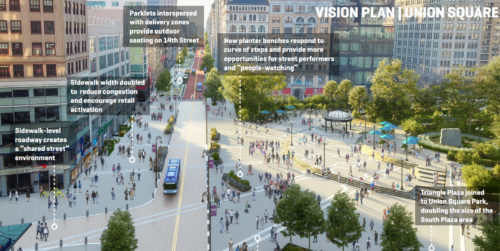
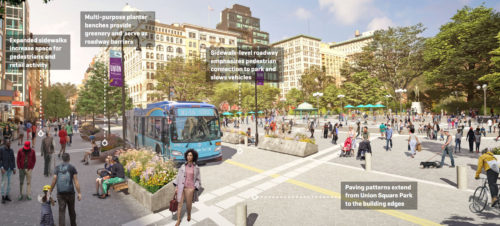
    The city’s Department of Transportation has declared its pedestrian plaza on the north side of Union Square, the fourth such major street revamping along Broadway, an out-and-out success, despite some early qualms from residents.

    The redesign, implemented about a year ago, banned most cars from the block of Broadway north of Union Square, between 17th and 18th Streets, and closed a traffic lane on Union Square North. Tables and chairs were placed on the closed-off areas, and the neighborhood’s green market was able to expand.

    The idea was to simplify a particularly tricky intersection where a confusing jumble of traffic signals and two-directional car lanes had resulted in a string of pedestrian injuries.

    But the plan initially met stiff opposition from residents and businesses in the area, who complained about traffic jams on residential streets and problems for delivery trucks. A raucous community board meeting resulted in outcry and a mass walkout from protesters.

    One year later, the city’s traffic engineers say that the improvements, for cars and pedestrians alike, have been palpable. (Here’s a pdf link to the report.) And no businesses or store managers appear to have registered complaints with local officials.

    Radar samples found that about 12 percent of cars on Broadway between 20th and 19th Streets were now exceeding the 30 mile-per-hour speed limit, down from 28 percent of cars before the changes. Pedestrians can navigate a shorter crosswalk at the north end of Union Square, and they are waiting a shorter time for a “walk” signal.

    Bicycle riders, who benefited from an additional protected lane along East 17th Street, also appear to be enjoying the changes: the agency found a 16 percent jump in cyclists in the area on weekdays, and a 33 percent increase on weekends.

    Still, automobile drivers now appear to be avoiding the stretch of Broadway south of Madison Square, where the street was reduced to a single lane of car traffic and the direct car connection through Union Square was severed.

    The number of cars traveling on that stretch has dropped by about half since the plaza was installed, the report said. Some of those drivers may be choosing to take Fifth Avenue or Park Avenue South for southbound trips through the area, slightly slowing those routes. The average speed of taxis along Fifth Avenue fell slightly after the plaza was installed, and southbound trips on Park Avenue South took longer.

    But the Transportation Department noted that average speed along West 18th Street, where residents were most fearful of jam-ups, rose by about 14 percent, to 7 m.p.h. from 6 m.p.h. And average speeds on Park Avenue South stayed relatively unchanged.

    The Union Square Partnership, the neighborhood’s economic development group, conducted a door-to-door survey of area businesses, and 60 percent of those who responded said they were happy with the new traffic configuration. About 35 percent had no opinion.

    Still to be determined: some illegal left turns at the always-dangerous perpendicular intersection of Union Square West and 14th Street. (Initially, the agency had hoped to close off parts of Union Square West entirely, but some businesses objected.) The city said it was working on new street adjustments to tackle the problem.

  • Union Sq. Park Restaurant Update

    We still don’t know who’s behind the design of the upcoming and controversial Union Square restaurant, but we do know who’ll be cooking there: chef Don Pintabona of O-V Hospitality Group, formerly of Tribeca Grill. In exchange for running the restaurant, O-V Hospitality has to invest $1.1 million in its construction. The design will “integrate historic elements of Union Square,” be called City Farm Cafe, and open in spring 2012.