NY Times Talks Up Union Square
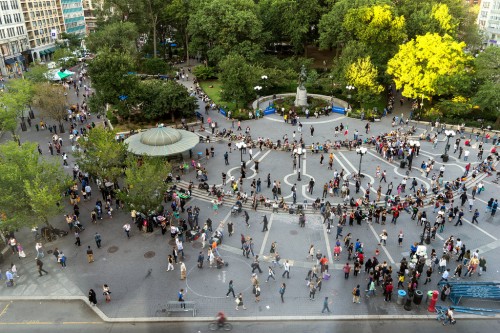 Did you catch the NY Times raving about Union Square? Good for real estate values.

Did you catch the NY Times raving about Union Square? Good for real estate values.
Once again, Jeremiah of Jeremiah’s Vanishing New York eulogizes another block lost to development, in this case the nearby block of 3rd Ave. between 13th and 14th Streets.
As construction for the Union Square tech hub begins, Greenwich Village preservationists have resurrected their call for the city to designate a new historic district in the area, AM New York first reported.
Last October, following a contested upzoning of a lot on 14th Street to build the 21-story training center, the Greenwich Village Society for Historic Preservation (GVSHP) asked the Landmarks Preservation Commission (LPC) to consider designating a new historic district to protect 193 buildings in the area.
Over the summer, the LPC moved to designate seven of those buildings, but rejected the call for a full historic district. At the time, the LPC said that the area mostly contains buildings erected between the 1830s and 1930s, as well as new and altered ones, and that because of their variety in styles, types, and dates, “[the area] lacks the consistent architectural quality, cohesiveness, and sense of place necessary to merit historic district designation.”
But GVSHP is persistent, and this week resurrected its call for a proper district protecting more buildings in the area. In a letter sent to LPC this week, the group made the case for protecting 10 buildings, including 10 East 14th Street, a cast-iron structure that once housed the NYC Woman Suffrage League headquarters; 72 Fifth Avenue, a masonry structure that was the headquarters of Appleton & Company; and 17 East 13th Street, the brick Erskine Press building. The selection of buildings also includes structures associated with 19th-century architect James Renwick Jr.
“[These buildings] speak to the incredibly rich and important social and architectural history of the area, and to New York’s development as the capital of commerce and culture in the late 19th and 20th centuries,” the letter from GVSHP reads.
“With increased pressure on the area from the beginning of construction on the 14th Street Tech Hub, the recent loss of Renwick’s St. Denis Hotel (1855), and the completion of the woefully out of scale tech office tower at 808 Broadway, the time for the city to act is now,” Andrew Berman, executive director of GVSHP, told Curbed in a statement.
The group is also pushing for city lawmakers to implement protections that would regulate commercial development south of 14th Street through a “protective zoning measure,” which was promised at the time of the tech hub rezoning over a year ago.
City Council member Carlina Rivera, who represents the area, negotiated those commitments from the de Blasio administration, but advocates have said those promises hadn’t materialized.
“Councilwoman Rivera continues to work with the community to ensure the history of the Village is preserved and she is meeting regularly with LPC to discuss future protections for her entire district that should be considered,” Jeremy Unger, a spokesperson for Rivera, said in a statement.
 Well, here is what our new neighbor on the southeast corner of 5th and 13th is going to look like, and here are all the details. Not bad. At least it aint all glass.
Exciting new for the neighborhood that proves that the 14th St. shareholders live in an important building: our neighbor at number 22, namely the Duane Reade building, has been landmarked by the city for its historical significance. This action protects it in perpetuity. The Greenwich Village Society for Historic Preservation gives us this historical background:
“The Baumann Brothers Furniture and Carpets Store was built in 1880-81 for James McCreery (1826- 1903), a well-known textiles merchant of Scottish descent. It was designed by the architectural firm of D. & J. Jardine, whose principals, David and John Jardine, were brothers also of Scottish birth. One of the more prominent, prolific, and versatile New York firms in the late-nineteenth century, D. & J. Jardine executed designs for a wide variety of building types, including a number of notable cast-iron fronts, in contemporary styles. The wide cast-iron front facade of the Baumann Brothers store is one of the firm’s and one of the city’s most inventive, unusual, and ornamental. Built toward the end of the heyday of cast-iron fronts in New York and the flourishing creativity in that material, the Baumann Brothers store is also a signal achievement of Aesthetic Movement design. An amalgam of ornamental influences, including neo-Classical, neo-Grec, and Queen Anne styles, is embraced to achieve a decorative overall composition. Another designed, though simpler, facade on 13th Street is clad in brick and stone with a cast-iron ground story. The building’s prime location was in the midst of Manhattan’s primary retail shopping district, which included 14th Street, Union Square, and Ladies’ Mile. From 1881 to 1897, it housed Baumann Brothers, a furniture-manufacturing company established c. 1870 by Albert and Ludwig Baumann, Bohemian Jewish immigrants. By 1884, the firm occupied the entire structure and billed itself as “the largest and most complete furnishing establishment in America.” A painted sign advertising Baumann Brothers is still visible on the building’s western wall. For eight decades, the ground story contained 5-10-and-25-cent stores, beginning with the fourth Woolworth store in Manhattan (1900-28), acclaimed at its opening “the largest ten-cent store in the world.” This space was later a store for F. & W. Grand, H.L. Green, and McCrory. The upper stories were leased for over eight decades for show rooms and manufacturing by various firms related to the textile and sporting goods industries, as well as a gymnasium and classrooms for the Delehanty Institute (1930-63), which trained candidates of the Police and Fire Departments. The building currently contains a drugstore, while the upper stories are used as an annex to the Parsons School of Design.”
This image looks southeast from the park toward the intersection of 14th St. and 4th Ave. in 1922, almost exactly 100 years ago. Note that at the time, the statue of George Washington stood at that corner.

The City Tavern across 13th St. has closed.