Similar Posts
A New Landmark on Our Block
ByDonExciting new for the neighborhood that proves that the 14th St. shareholders live in an important building: our neighbor at number 22, namely the Duane Reade building, has been landmarked by the city for its historical significance. This action protects it in perpetuity. The Greenwich Village Society for Historic Preservation gives us this historical background:
“The Baumann Brothers Furniture and Carpets Store was built in 1880-81 for James McCreery (1826- 1903), a well-known textiles merchant of Scottish descent. It was designed by the architectural firm of D. & J. Jardine, whose principals, David and John Jardine, were brothers also of Scottish birth. One of the more prominent, prolific, and versatile New York firms in the late-nineteenth century, D. & J. Jardine executed designs for a wide variety of building types, including a number of notable cast-iron fronts, in contemporary styles. The wide cast-iron front facade of the Baumann Brothers store is one of the firm’s and one of the city’s most inventive, unusual, and ornamental. Built toward the end of the heyday of cast-iron fronts in New York and the flourishing creativity in that material, the Baumann Brothers store is also a signal achievement of Aesthetic Movement design. An amalgam of ornamental influences, including neo-Classical, neo-Grec, and Queen Anne styles, is embraced to achieve a decorative overall composition. Another designed, though simpler, facade on 13th Street is clad in brick and stone with a cast-iron ground story. The building’s prime location was in the midst of Manhattan’s primary retail shopping district, which included 14th Street, Union Square, and Ladies’ Mile. From 1881 to 1897, it housed Baumann Brothers, a furniture-manufacturing company established c. 1870 by Albert and Ludwig Baumann, Bohemian Jewish immigrants. By 1884, the firm occupied the entire structure and billed itself as “the largest and most complete furnishing establishment in America.” A painted sign advertising Baumann Brothers is still visible on the building’s western wall. For eight decades, the ground story contained 5-10-and-25-cent stores, beginning with the fourth Woolworth store in Manhattan (1900-28), acclaimed at its opening “the largest ten-cent store in the world.” This space was later a store for F. & W. Grand, H.L. Green, and McCrory. The upper stories were leased for over eight decades for show rooms and manufacturing by various firms related to the textile and sporting goods industries, as well as a gymnasium and classrooms for the Delehanty Institute (1930-63), which trained candidates of the Police and Fire Departments. The building currently contains a drugstore, while the upper stories are used as an annex to the Parsons School of Design.”
A Look Back at the Long Lost Union Sq. Theater
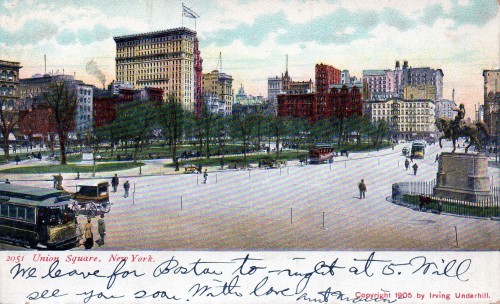
ByDonJeremiah’s Vanishing New York has a look back at the old Union Square Theater, which once stood on the site of the big (former) Virgin store building on 14th St. Interesting!
Fifth Ave. and 13th St. in 1939
ByDonThanks to Charles Stimson we are gifted with six more images of yesteryear. This one shows the east side of Fifth Ave. at 13th St. See Schrafft’s on the corner, which is now the burned out deli? Remember that you can double click on all these images to get a much closer look at some of the detail. The views of 14th St. are especially interesting. The trucks, the signs, the decorative cornices, including the one on our building . Enjoy.

Big Effort to Landmark Seven Nearby Buildings
ByDonThe buildings feature various architectural styles and were home to garment manufacturers in the late 19th and early 20th centuries. On September 25, 2018, the Landmarks Preservation Commission unanimously voted to add seven buildings to its calendar for consideration as individual landmarks. The buildings are located at 817 Broadway, 826 Broadway, 830 Broadway, 832 Broadway, 836 Broadway, 840 Broadway, and 841 Broadway. All of the buildings are south of Union Square in Manhattan.
The Landmarks Research Commission studied the area south of Union Square between 5th Avenue and 3rd Avenue, including where Broadway intersects the area, for historical preservation opportunities. The Landmarks Research Commission selected the seven buildings for their distinctive, intact architectural features and the importance of the buildings in Broadway’s history. The buildings were built between 1876 and 1902, a period where this area south of Union Square experienced rapid commercial development from a growing garment industry. Many of these buildings highlight innovative construction methods for this time, including the use of steel frames, electricity, and elevators. Of the seven buildings, five were built in the Renaissance Revival style.