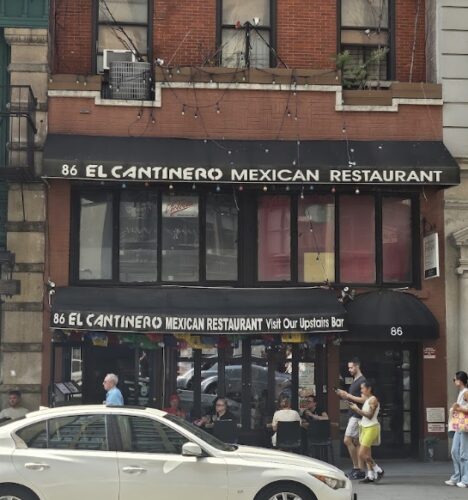
Gone: Babu Ji

Another pandemic victim: Babu Ji on 13th St. It was the sixth restaurant to have a go of it in the space in the past 25 years.

Similar Posts

  • Cereal Killer: Kellogg’s Cafe is Over

    Gothamist reports:

    A cereal saloon? In Union Square?? In this economy??? Not anymore, I’m afraid: The Kellogg’s NYC cafe, a large windowed box where tourists could pay too much to eat cereal suspended in midair, has closed. “Closed abruptly,” according to Eater, its empty husk reimagined as a holiday pop-up slinging fancy donuts.
    The Kellogg’s NYC website confirms the closure: “We are sincerely thankful for the support of all our great guests of this unique cereal experience,” it screams in all caps. “While Kellogg is busy creating the next adventure, the Union Square Space will be open as a White Box space through our partner Co.Create NYC for events.”

    If, in turn, you were wondering what a White Box space is, here’s some start-up word salad for you to digest: “The White Box is where brainstorms become brand activations, product innovations become pop-ups, fever dreams become private parties.” (On which most of Union Square would theoretically be able to spy, considering the whole storefront is glass.)

    In June of 2016, Kellogg’s NYC opened its first cereal cafe in Times Square, offering tourists bowls of refined carbohydrates for the totally-reasonable-what-do-you-mean price of $6 to $8. The menu had been enhanced by Christina Tosi of Momofuku Milk Bar, possibly to justify the price, I guess? Anyway, the venture’s perhaps improbable success prompted a move to a bigger space overlooking Union Square in 2017, a boom year for Instagrammable cereal, for whatever reason. Located at 31 East 17th Street, the new digs were more than five times bigger than the old ones, according to Eater. Kellogg’s dropped prices — $1.50 for your basic bowl of Frosted Flakes (a family-sized box of which currently costs $3.79 at Target) or Special K; $4 for a jazzed-up bowl with toppings — but this more affordable fare does not appear to have done the trick.

    Kellogg’s NYC did not address Gothamist’s questions about the reason for the departure, so we can’t say for sure what prompted the closure. Still, a slew of better-established businesses have vacated the neighborhood in recent months and years, typically citing rents rising at wildly unrealistic rates. Coffee Shop shuttered in October 2018, to be replaced by a Chase Bank and by CHLOE. In January, Blue Water Grill closed its doors, a spokesperson for its owner (an actual billionaire) explaining, “Even though this is one of New York’s most successful restaurants, it can’t be successful with a $2 million plus rent.” In 2017, popular eatery Republic announced its impending relocation, due to the mounting financial burden of a Union Square lease, and in 2015, Danny Meyer explained that he had to move his Union Square Cafe because of “untenable rent escalations.”

    Meanwhile, demand for Kellogg’s product has reportedly been waning across the board. Without knowing exactly how much it costs to rent a centrally located sky lounge, one designated specifically for the consumption of Frosted Mini Wheats and their ilk, it’s hard to guess at the overhead Kellogg’s NYC faced. It seems reasonable to expect, though, that the rent would be high — too high, even, for Big Cereal to justify?!?! What have we come to??

    But take heart, my Froot Loops, because a statement from Kellogg’s suggests the brand isn’t done with you yet:

    We have been lucky to have wonderful support from cereal fans and media alike. We are committed to continuing to bring more unique and engaging experiences to Kellogg’s cereal fans in the future. Kellogg has loyal, passionate fans that constantly seek the chance to interact with our iconic brands. We believe this includes in-person experiences that push the imagination and provide unexpected opportunities to experience cereal, something they’ve been connected to their entire lives, in a completely new way. That was our belief when we opened the first café and fans have responded positively and asked for more ever since. Stay tuned for updates on our next chapter!

  • NYC Sends Wrong Property Tax Abatement Info

    PLEASE READ: YOU MAY HAVE RECEIVED A LETTER FROM THE CITY IN ERROR:
    Tens-of-thousands of city residents eligible for a popular condo and co-op tax break have received letters from the city incorrectly stating that they no longer qualify, according to city civic and co-op board leaders.

    Late last week, co-op and condo owners began receiving the letter from the city Department of Finance stating that a revamped condo and co-op tax abatement bill passed by the Legislature in January meant they could not collect it. “Our records show that this unit is not your primary residence, so your abatement will be phased out,” the letter states. The new legislation only allows owners to claim the tax break on their primary residence, and no longer allows the break on secondary homes.

    The problem was that many people received the letter at their primary residence—which is indeed still eligible for the full break, according to Warren Schreiber, co-president of the Co-Op and Condo Council in northeast Queens. Mr. Schreiber said in his own co-op of about 200 residences, some 45 people had received the letters— about 35 of whom actually count those units as their primary residence. That could make a difference of about $1,000 per unit on upcoming bills if not corrected, he said.

    “Some people have been in their homes, 20, 30 or 40 years and are getting these letters,” said Mr. Schreiber. “I think what happened is that the Department of Finance’s records are out of date, but it’s causing a lot of confusion and chaos.”

    Nearly two years ago, Finance Commissioner David Frankel acknowledged the department had erred on 15,000 property bills the city mailed that July because of a “computer glitch.”

    But in this case, a Department of Finance spokesman said the agency had used available data to determine which of the city’s 360,000 condo and co-ops would qualify for the abatement, and automatically enrolled 230,000 of them. In instances where there was not enough information, the agency sent out 130,000 of the letters to homeowners saying were not eligible for the tax break.

    Mary Ann Rothman, the executive director of the Council of New York Cooperatives & Condominiums, said she too had been contacted by several people who have received the letters—despite simultaneously receiving the state’s STAR tax rebate on the same property, which can only be claimed at one’s primary residence.

    Still, she defended the city Department of Finance, arguing that it was simply sending the letters out to the large number of co-op and condo owners in an effort to make sure the city’s records were correct under the revamped program.

    “This is making people nervous, but you have to remember that this is a total change in the way that the abatement is administered,” she said.

    The letters the city sent to co-op owners directs them to send a form to an address in Maplewood, N.J., verifying that they are in fact receiving the abatement on their primary residence. The form is due on April 1, and city tax bills reflecting whether the abatement will still be granted will go out in June. Those no longer eligible for the abatement would retroactively have to pay 50% of the normal break in July, and would stop getting it altogether in July 2014.

    But Mr. Schreiber said he was concerned that elderly property owners, those with disabilities or those who live elsewhere for the winter, would have their tax break incorrectly pulled.

    The parameters of the new condo and co-op bill were originally hashed out in June 2012, but Gov. Andrew Cuomo at that time decided not to issue a message of necessity circumventing a three-day waiting period to pass it before the end of the legislative session. As a result, the city Department of Finance decided essentially not to collect hiked condo and co-op taxes under the expectation that the legislature would eventually pass the agreed-upon bill—which it finally did this January.

    The revamped program offers greater benefits to middle-class owners, raising their tax abatements from 17.5% to, 26.5% next year and 28% in 2015 for properties whose average assessed value is less than $50,000. Units valued at more than $60,000 would get abatements of 17.5% over the next three years. Other previous aspects of the program—including one that allowed real estate speculators to claim abatement for secondary residences—were eliminated.