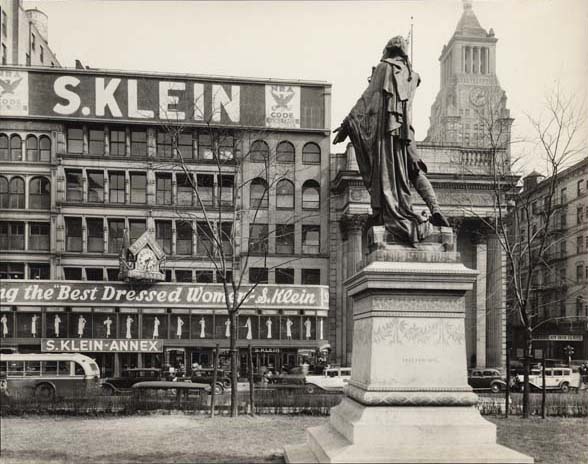
Pret a Manger to Union Square
Tisserie, the fancy pastry shop that closed at the northwest corner of Union Square, will be replaced by popular British-based sandwich shop Pret a Manger. They have rather good coffee, by the way.

Tisserie, the fancy pastry shop that closed at the northwest corner of Union Square, will be replaced by popular British-based sandwich shop Pret a Manger. They have rather good coffee, by the way.
Next week (March 19 to March 23), Superstructure work will continue at the 8th floor level. Deliveries for the internal systems of the building have been ongoing and will continue, although they should not greatly affect the flow of pedestrian and road traffic.
The following week (March 26 to March 30), we will continue superstructure concrete and slabs on the 8th and 9th floor levels. Deliveries for the internal systems of the building have been ongoing and will continue, although they should not greatly affect the flow of pedestrian and road traffic.
This weekend the site will be open on Saturday, March 17th for superstructure related activities between the work hours of 7AM and 5PM as permitted by the City. To control noise levels within the site, work activities will be limited to the placement of formwork and concrete, plumbing and electrical work, rebar for concrete placement, using the crane and equipment to support all activities. Safety horns are used, and required by law, to coordinate lifting with the crane and to alert the workers of the danger overhead. We have directed the operators to limit the use of horns to one short sounding and to use the crane later in the day so as to avoid any excess noise.
In addition, tomorrow, Friday the 16th, we will be starting operations at 6am in anticipation of a large concrete pour and will more than likely, with notification of the Department of Buildings, be going later into the evening to finish. Also on the weekend of the 10th the 14th St. Con Ed Vault utility connection street work will continue per DOT Permit granted for weekends only.
From DNAinfo:
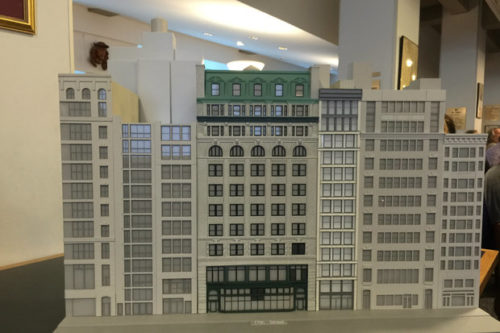
A developer’s plans to knock down two buildings in an historic district near Union Square to make room for new apartment towers, was shot down by the local community board, who say the integrity of the neighborhood and the retail options there should be preserved. Developer C.A. White wants to tear down two buildings at 21 W. 17th St. and 16 W. 18th St. to build 13- and 11-story apartment buildings in their place. The current buildings, which are significantly shorter, are occupied by a Rent a Runway shop and an empty storefront, formerly home to the restaurant BLT. They’re also a part of the Ladies Mile Historic District, and would ultimately need approval from the Landmark Preservation Commission to be altered.
7 For All Mankind has opened on the corner of 5th Ave. and 15th St. at the former site of Au Bon Pain. So instead of a $3 muffin you can get a $300 pair of jeans.
For the next two weeks, through May 6, the New School reports that construction will be basically “more of the same.” In other words, they’re still digging the hole.
Many people believe that Union Square got its name from the many labor demonstrations that took place here back in the day. Not true. The reason for the name is much more simple: Union Square was the location of the “union” of Broadway, 4th Avenue (aka Park Ave. South), and University Place. Nothing more complicated than that.