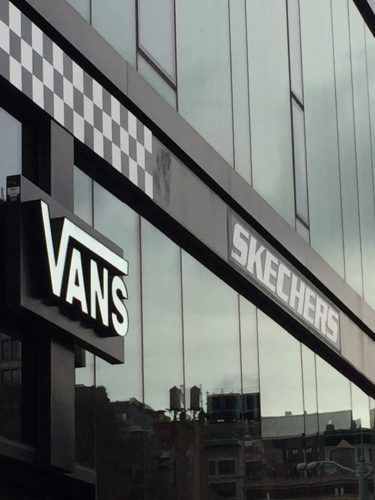
Because We Need More Sneakers in Union Square

Here’s the pretty big news about upcoming traffic redesign and new pedestrian areas in and around Union Square:
A plan to reshuffle traffic around Union Square and add a new pedestrian plaza nearby has been given the final green light after months of contentious debate.
Community Board 5 voted overwhelmingly in favor of the Department of Transportation’s plan for the square despite continuing cries from a group of vocal residents who say the changes will only make traffic in the congested neighborhood worse.
The revised plan, which the DOT will begin implementing in the coming months, will restrict traffic to one-way westbound on E. 17th Street between Broadway and Park Avenue South.
Broadway will be narrowed to one lane from 17th to 23rd streets, and a new pedestrian plaza will be added to the east side of Broadway between 17th and 18th streets. The exact design of the plaza, including whether or not it will have tables and chairs like Herald Square and Times Square, is still up for debate.
To improve traffic on Park Avenue South, southbound cars will be prohibited from turning left at 18th Street, while northbound cars will be banned from turning left onto 19th and 23rd streets, among other restrictions.
Numerous dedicated turning lanes will also be added, in addition to new protected bike lanes and revised parking schemes.
The DOT’s Ryan Russo said the department hopes the plan will make the stretch more pedestrian-friendly, less chaotic and cut accidents in half.
Nonetheless, a handful of residents continued to complain that they’ve been left out of the decision process and haven’t been given enough time to consider the changes.
“I think this plan is being rushed to the extreme and rammed down neighbors’ throats,” lawyer Milton Meyers, 63, a 20-year resident of 18th Street and Irving Place, told the standing room-only crowd at the CB5 meeting Thursday.
Artist Silvia Kolbowski, who has collected more than 300 neighborhood signatures opposing the plan, accused the DOT of caring less about improving safety than pushing through another pedestrian plaza as part of a larger city plan.
“If the issue was safety at the crossings, then surely this plan is overblown,” said Kolbowski, 56, who has lived on East 18th Street at Park Avenue South for a decade. The plan, she said, will create “nothing but chaos.”
While such opinions were overwhelming when the idea was first presented back in April, opposition has faded as the DOT has made revisions, including dropping an initial plan to completely shut down Broadway to traffic between E. 17th to 18th streets at certain times of the day.
Numerous organizations, including representatives from New York University, the Union Square Green Market, the Union Square Partnership, and Transportation Alternatives have now joined in support of the plan.
“This neighborhood has a chance to have some significant safety improvements that other neighborhoods are clamoring for,” dance instructor, Detta Ahl, 31, who lives in Morningside Heights but frequently cycles in the area, told the audience.
The plan was ultimately adopted on a ‘pilot’ basis, with a provision that the DOT return in three and six months after implementation to report on the results.
How annoying. The New School construction site seems to be getting its daily dumpster deliveries at 4:15AM. So noisy. Good morning!
Brit chain Pret A Manger had moved into the former Tisserie space at 857 Broadway (at 17th Street), and now comes official word that when it opens for a test run this Friday, it will give away 3,000 free sandwiches starting at 12:15 p.m. — provided you snag one of the flyers that will be given away at the Union Square subway entrances between 8 a.m. and 9:25 a.m. that morning. Pret is calling this the “Guinea Pig Day” for what will be their U.S. flagship (the store features a fresh design and free Wi-Fi), but for better or worse, cuy won’t be served — instead, Pret is sourcing food directly from Greenmarket vendors. The location opens fully on June 22.
Au Bon Pain on 5th Avenue….dunzo.
Due to an increasing number of thefts of UPS packages which are left unattended by the UPS delivery man outside shareholders’ doors, the procedure will now change. UPS will no longer leave packages unattended upstairs. Instead, he will place them behind the locked door off the lobby, to which he and Niall will have a key. A notification of package arrival will be on the bulletin board. You can then get in touch with Niall to get the package.
Please address any questions to Niall.