Hurricane Irene: Be Ready
The main thing to do to prep for Hurricane Irene is to remove anything from outside your apartment–on roof spaces or fire escapes–that could blow away in heavy and sustained winds. Please do this ASAP.

Here’s an update on Union Square reconstruction:
Work is progressing quickly to repave the 16th Street transverse. Crews are laying a new concrete base to better support the asphalt pavers for this heavily-trafficked portion of the park. Special care is being taken to preserve the root systems of the elm trees that bisect the pathway, and access to the center lawn for the disabled will be part of the final design. Repaving is expected to be completed by Labor Day.
The center and east play areas are also moving along, with equipment installation nearly complete for both sections. The enormous Big Mountain play feature, fabricated by a silo manufacturer on Long Island, was welded together on site last week. The bulk of the remaining work will encompass retaining wall, decorative fence and bench installation, and final landscaping. In other construction news, Pavilion roof waterproofing, flashing and cornice work continues, as does new plaster work on the interior ceiling. Concrete and paver installation on the east plaza was recently finished, and excavation will soon begin on the east sidewalk south of the 16th Street transverse.
Beacon’s Closet has a competitor. 2nd St., a Japanese company, is now selling high-end vintage clothing at 110 University Place.

The Union Square area is becoming a high-tech hotbed. Mashable CEO Pete Cashmore was interviewed about why he brought his company here:
Last September, Pete Cashmore moved Mashable’s headquarters from 23rd Street to the heart of Union Square. What he found when he arrived was a climate he says is perfect for startups.
Factors that play into the business climate he found just a few blocks south of Mashable’s previous location include a fertile history of innovation, access to creative talent, and proven professionals. But in the end, what’s most attractive to Cashmore is good, old-fashioned, face-to-face interactions.
“Union Square has always been a meeting place, where people come together and share ideas,” Cashmore told me on Tuesday at an event at the British Residence of New York. “And now with it becoming a real hub of innovation it is a great place to be.”
Now employing about 140 people, Mashable’s offices occupy two floors on Fifth Avenue and 17th Street.
No doubt, part of what Cashmore found there was nurtured by venture capital firm, Union Square Ventures (USV), which was founded in 2004 and now manages $1 billion in assets across six funds. USV’s previous investment in New York City-based companies include Etsy (Nasdaq: ESTY), Tumblr (acquired by Yahoo for $1.1 billion), and MongoDB, which has raised $311 million venture capital.
But over the past year, the number of significant real-estate investments in Union Square shows that it’s much more than just Fred Wilson’s influence at work in the area.
The top three lease transactions of 2015 are BuzzFeed, which now occupies 194,000 square feet at 225 Park Avenue South, Gawker Media, which is in 58,900 square feet at 114 Fifth Avenue, and First Look Media in 58,206 square feet at the same location, according to a Union Square Partnership report published in May. New and expanded office tenants in Union Square also include Dropbox, Adobe Systems Inc. Hulu, Lippe Taylor, Pop2Life, Capital One Labs, The New Republic, and Compass.
The top sector in the area is “professional, scientific, and tech services,” with 1,514 firms, followed by retail with 1,393 firms. Among the top firms by number of employees is J. Crew, listed with 3,800 employees and Tory Burch, with 1,800. In total, 9,700 businesses are located within the half-mile radius of Union Square considered by the report, employing over 153,000 people.
What’s attracting all this talent? Not the rent. According to a May report by San Francisco-based real estate analytics firm Zumper, only two neighborhoods are more expensive than Greenwich Village, where Union Square technically is designated as being located. Average rent for a one bedroom apartment costs $3,850. In Chelsea it’s $3,920, and in Tribeca, $4,450. According to the same report, New York City was the second most expensive city in the United States, just behind San Francisco.
In an interview Wednesday, Union Square Partnerships managing director Scott Hobbs ventured his own theory as to why so many innovative companies are moving to his neighborhood. “The biggest reason is it’s a transportation hub,” he said. “You’ve got Williamsburg for creatives across the river, and midtown for business.” Trains that depart Union Square Station are the N, R, Q, 4, 5, 6, and L.
As for Cashmore, his explanation is much more simple. “What’s really great about Union Square is you can go get a coffee and bump into someone doing something interesting in tech,” he said.
Here’s an article from The Villager about the success of the Union Square Partnership:
The Union Square Partnership held its 24th annual meeting at the W Hotel on Thursday last week celebrating the progress of the city’s first business improvement district and the beginning of the long-awaited reconstruction of Union Square Park’s north end and the square’s northern plaza.
Danny Meyer, Partnership co-chairperson, presented the annual Community Service Award to Debbie Hulse, the Department of Parks and Recreation’s head gardener for Union Square Park for the past four years.
Jennifer Falk, the Partnership’s executive director, celebrated the BID’s accomplishments over the past year in sanitation (removing 1,749 tons of trash last year) and business promotion, including a new Web site, a new free walking tour and the new Visitor Map & Guide, 50,000 copies of which will be distributed in the area.
“Every year, the Partnership makes a series of targeted investments in the beautification of Union Square Park and our partners like Debbie Hulse help us achieve our goals,” Falk said. “Debbie has poured her heart into making Union Square Park one of the most beautiful destinations in New York City.”
Manhattan Borough President Scott Stringer spoke at the June 5 meeting and called Falk “a powerhouse” for her energy in looking after the city’s number-one BID and her concern for residents in the district.
George Kroenert, Parks Department team leader for the Union Square north-end reconstruction, outlined the scope of the project that began at the end of April and that will triple the current playground’s size, renovate the north-end pavilion and add water and electrical connections for Greenmarket farmers’ trucks.
The Greenmarket, now occupying the square’s west side while the north end is under construction, will return to the north end in phases as sections of the plaza are completed, Kroenert said.
The project’s hoped-for completion date is October 2009, Kroenert said.
“But we’re going to take our time and do the right thing,” he said. “We’re at 6 percent complete and we’ve used up 8 percent of our time, and the contractor has committed to keeping the playground closed for only one summer.”
Meanwhile, outside of the W Hotel around the north-end plaza, exuberant demonstrators, some in costume, were protesting against the proposal to install a seasonal, private restaurant in the pavilion once it’s restored. The evening before, Reverend Billy of the Church of No Shopping, real name Bill Talen, managed to get into the construction area to hang a banner that said, “Not for Sale” from the pavilion’s roof.
A court order last month allowed construction on the plaza and the pavilion to proceed, but restrained any work that pertains to any restaurant in the pavilion pending the outcome of a lawsuit that seeks to keep private restaurant concessionaires out of the pavilion.
One of the protesters last Thursday, Kurt Opprecht, a member of Billionaires for Bush, the satiric protest group, came into the annual meeting at the W Hotel and during the open question period referred to “the rabble-rousers outside who don’t realize that money doesn’t grow on trees.” Opprecht said later that his remark at the meeting was meant satirically, but the satire was missed.
Carol Greitzer, a former city councilmember who has opposed the project because of the proposed restaurant concession, was inside at the W Hotel meeting.
“This is going to be strange coming from me, but Robert Moses built 800 playgrounds in the city and he did it without the help of commercial restaurants,” Greitzer said.
Also on June 5, City Councilmember Rosie Mendez issued a public letter about why she supports the project after have opposed it in the past. Instead of doubling the current playground area as originally proposed, the current plan triples the playground size to nearly 15,000 square feet, Mendez noted. And instead of a year-round restaurant in the pavilion, the plan was changed to a six-month, seasonal concession. Mendez also noted that Luna Park, the previous outdoor restaurant around the outside of the pavilion, occupied 6,507 square feet. The seasonal concession planned for the pavilion is 3,732 square feet, she noted.
“At first, I only heard from those opposed to the plan,” Mendez said. “But as the plan evolved, the feedback my office received was very mixed. Some residents expressed their support for the plan, eager to quickly build the playground and refurbish the pavilion regardless of its use.”
Moreover, while many people said they feared that 17th St. on the north side of the plaza would be expanded and take away plaza space, the row of trees planned for the north end of the plaza will be planted a few feet into the 17th St. roadbed, increasing the size of the plaza, Mendez noted.
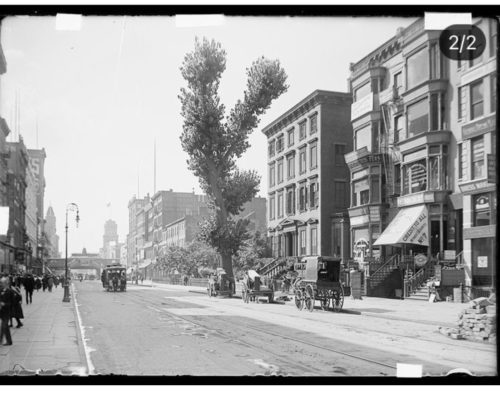
This is the north side of West 14th St. looking west from 5th Ave. in 1909. The 6th Avenue elevated train station crosses the street in the distance.